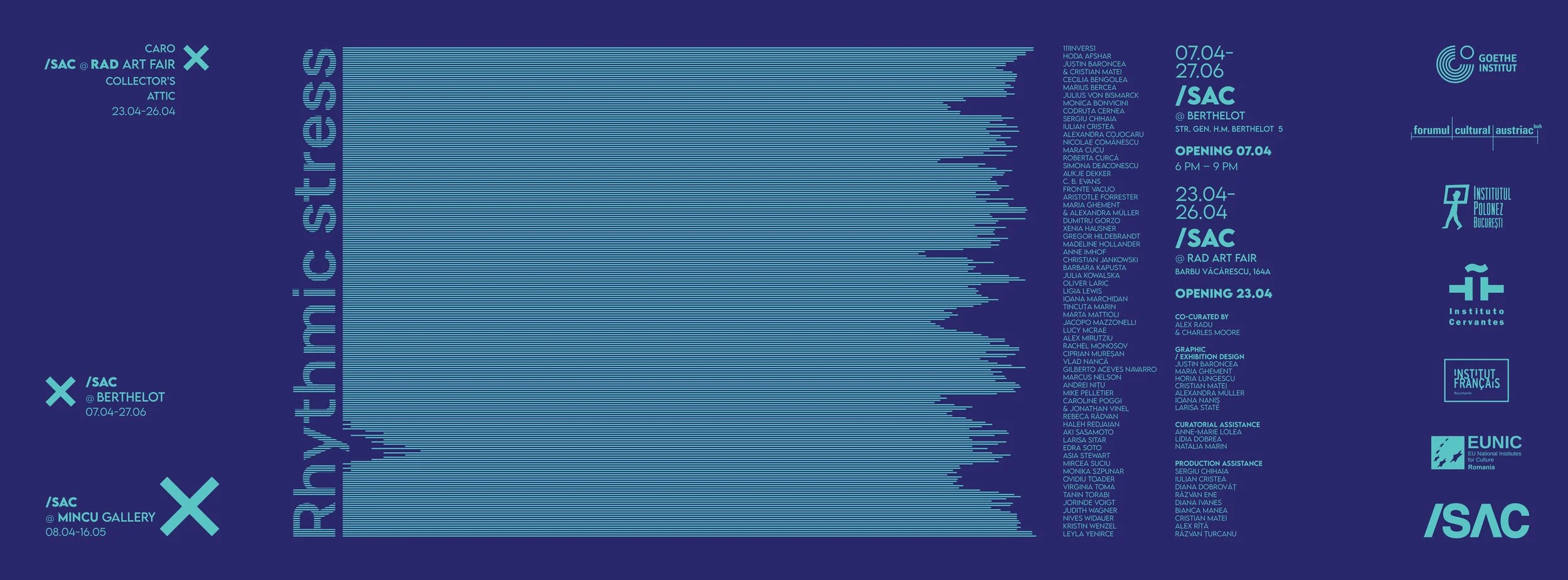
RHYTHMIC STRESS / TENSIUNI ÎN RITM
co-curated by Alex Radu and Charles Moore.
exhibition/graphic design: Justin Baroncea, Maria Ghement, Horia Lungescu, Alexandra Müller, Ioana Naniș, Larisa State
curatorial assistance: Anne-Marie Lolea, Lidia Dobrea, Natalia Marin
production assistance: Sergiu Chihaia, Iulian Cristea, Diana Dobrovăț, Răzvan Ene, Diana Ivanes, Bianca Manea, Cristian Matei, Alex Rîță, Răzvan Țurcanu
RHYTHMIC STRESS / TENSIUNI ÎN RITM
07.04-27.06.2026 /SAC @ BERTHELOT
artists: 111invers1, Hoda Afshar, Justin Baroncea & Cristian Matei, Cecilia Bengolea, Marius Bercea, Julius von Bismarck, Monica Bonvicini, Codruța Cernea, Sergiu Chihaia, Iulian Cristea, Alexandra Cojocaru, Nicolae Comănescu, Mara Cucu, Roberta Curcă, Simona Deaconescu, Aukje Dekker, C. B. Evans, Fronte Vacuo, Aristotle Forrester, Maria Ghement & Alexandra Müller, Dumitru Gorzo, Xenia Hausner, Gregor Hildebrandt, Madeline Hollander, Anne Imhof, Christian Jankowski, Barbara Kapusta, Julia Kowalska, Oliver Laric, Ligia Lewis, Ioana Marchidan, Tincuța Marin, Marta Mattioli, Jacopo Mazzonelli, Lucy McRae, Alex Mirutziu, Rachel Monosov, Ciprian Mureșan, Vlad Nancă, Gilberto Aceves Navarro, Marcus Nelson, Andrei Nițu, Mike Pelletier, Caroline Poggi & Jonathan Vinel, Rebeca Rădvan, Haleh Redjaian, Aki Sasamoto, Larisa Sitar, Edra Soto, Asia Stewart, Mircea Suciu, Monika Szpunar, Ovidiu Toader, Virginia Toma, Tanin Torabi, Jorinde Voigt, Judith Wagner, Nives Widauer, Kristin Wenzel, Leyla Yenirce
*
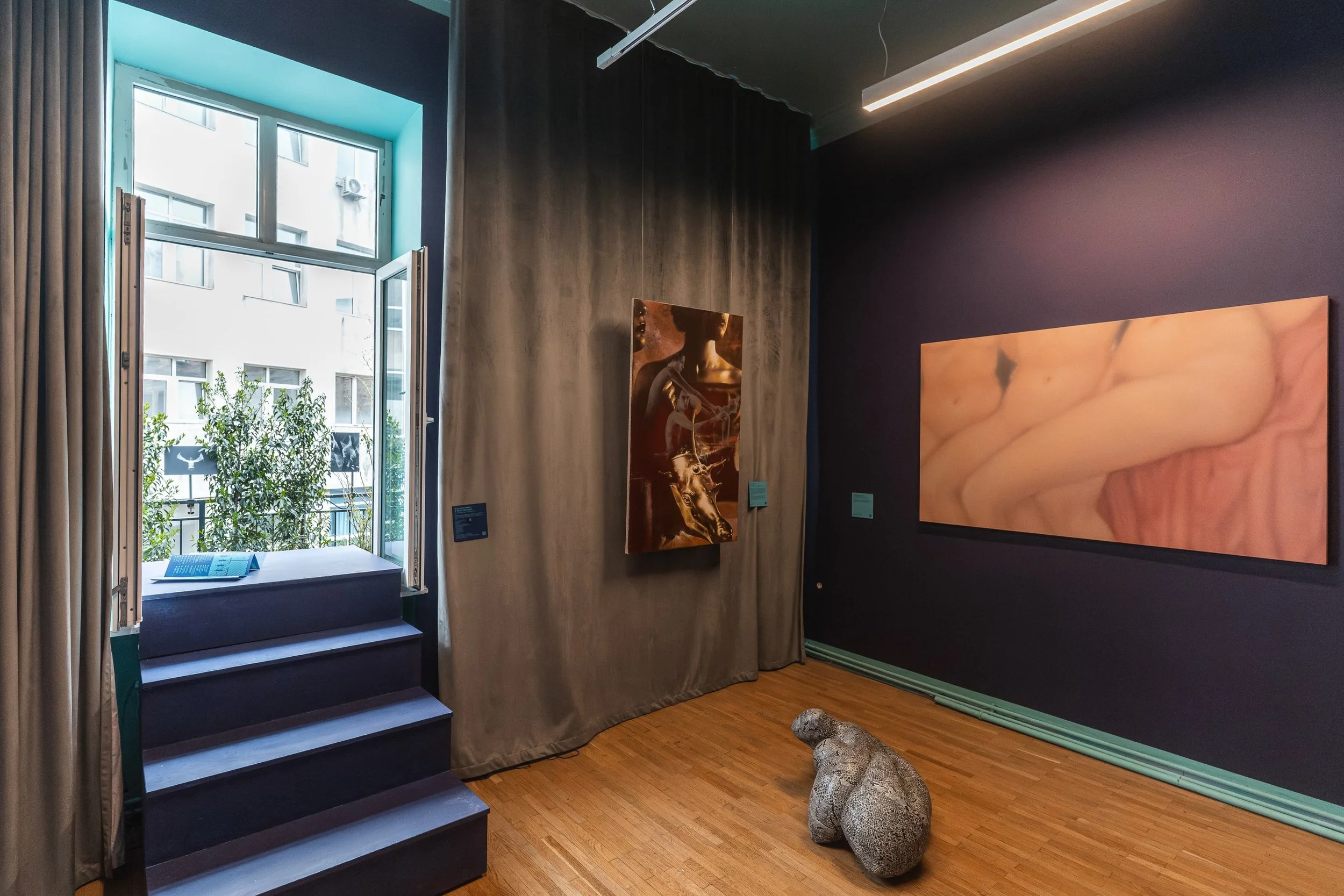
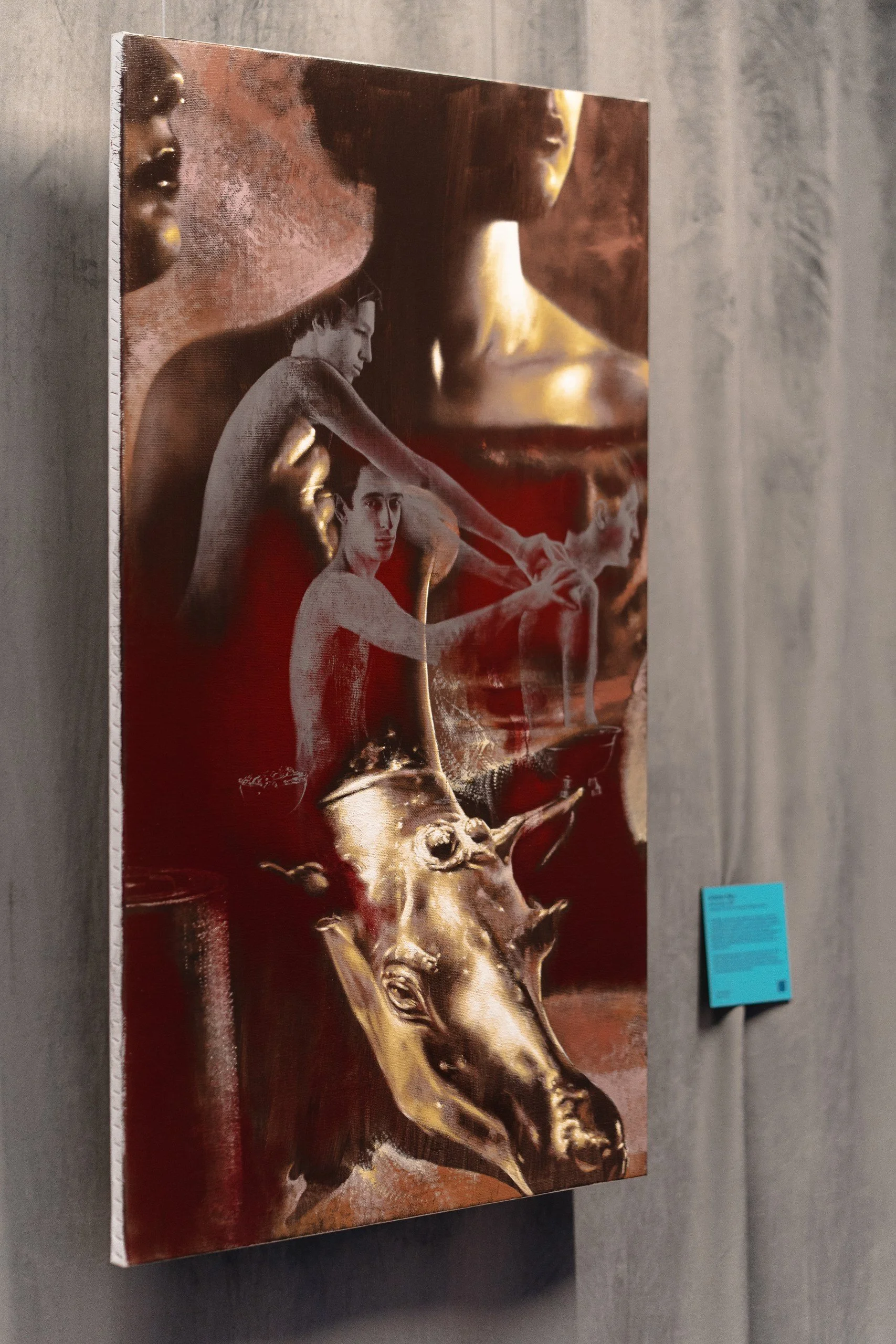
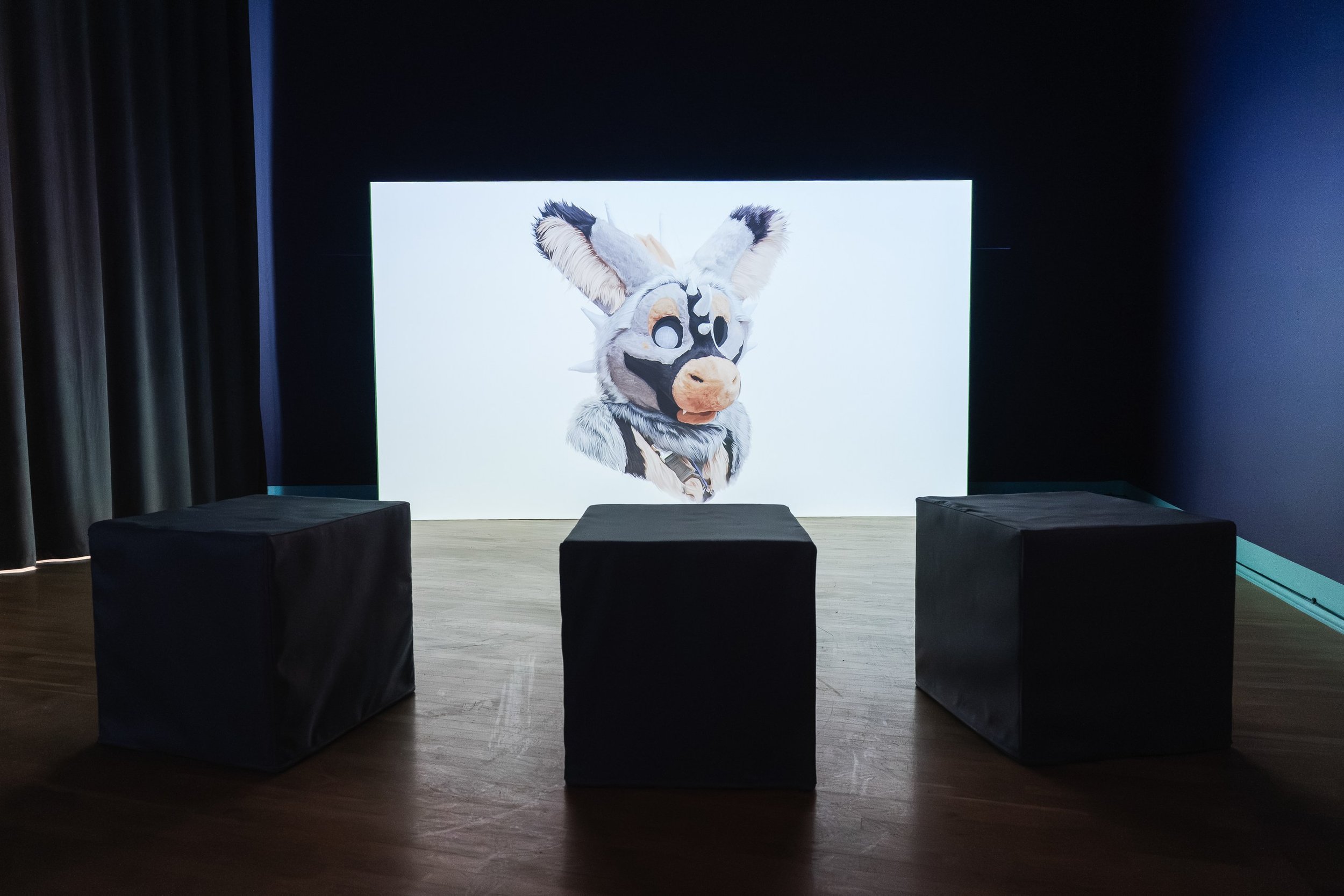
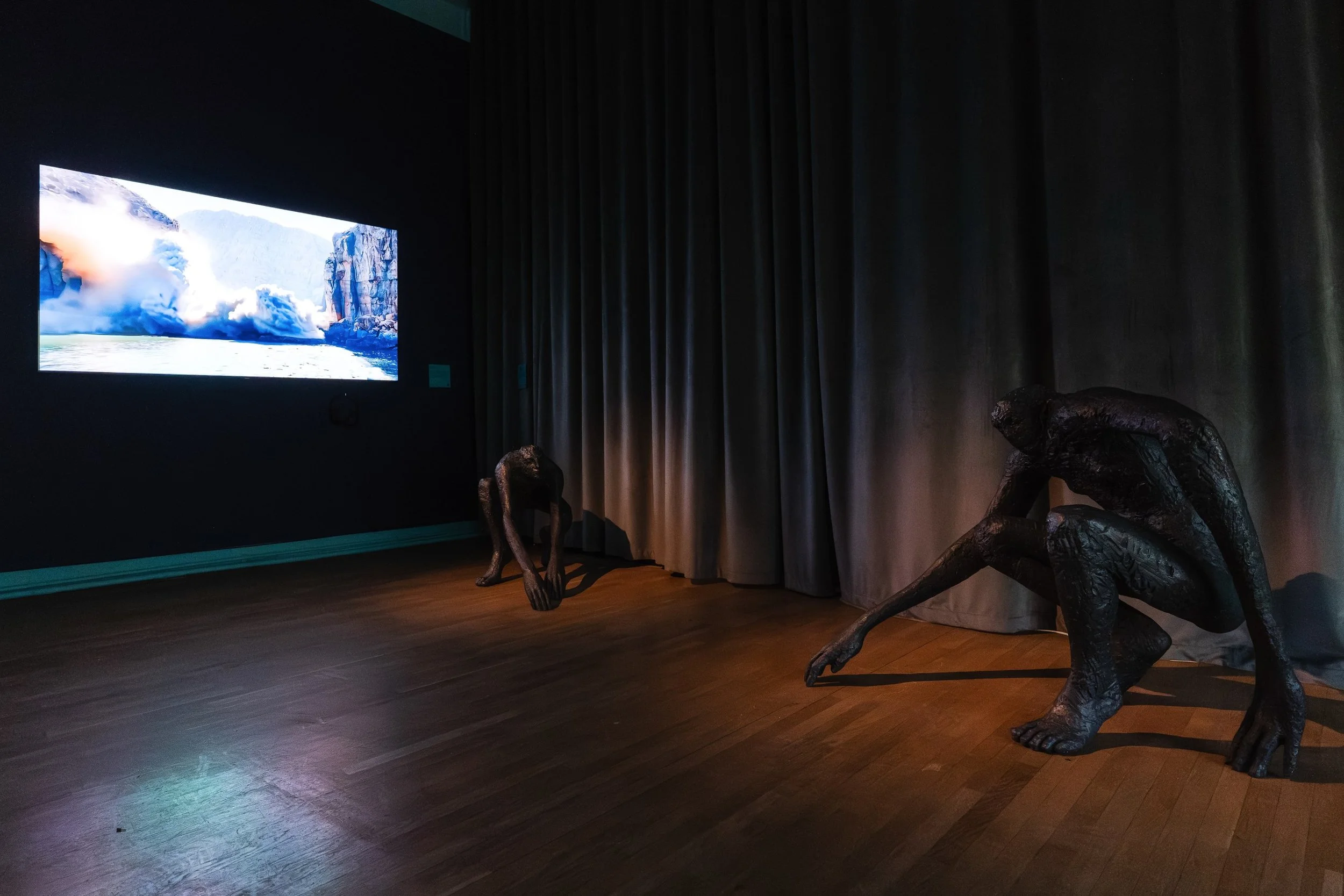
“Rhythmic Stress” is an inquiry into movement, the movement of bodies, of breath, of images, of language, of architecture, of power. It is an exhibition conceived at the intersection of dance, performance, contemporary art, and spatial practice, where rhythm becomes both a material condition and a political force. Approaching movement not as ornament or spectacle, the conversation instigated by these works becomes a primary strategy for negotiating tension: tension between stillness and eruption, control and release, endurance and collapse, private sensation and public consequence. In this sense, “Rhythmic Stress” positions movement as a response to violence, loss, systemic injustice, and the accumulation of micro-events that shape our bodies long before they become legible as history.
At its core, the exhibition asks how rhythm, understood as a temporal, corporeal, and social structure, operates under pressure. How does stress manifest in the body? How is it rehearsed, absorbed, resisted, or transformed through gesture, repetition, breath, and spatial navigation? And how might dance, choreography, and performative practices offer models for survival, protest, acceptance, or collective recalibration within societies permeated by inequality and rupture?
“Rhythmic Stress” considers movement as a way of thinking and as a way of being. It frames dance, performance, and embodied action as both deeply personal and irreducibly political gestures. These are modes of resistance and repair that operate across scales, from the intimate to the structural. Rage, grief, and exhaustion coexist here with release, liberation, and forgiveness. The exhibition rather creates a field in which contradictory states are allowed to cohabitate, collide, and reconfigure rather than demand resolution.
The exhibition is situated within a broader curatorial commitment to examining what brings us together, what separates us, and how relationships between bodies, communities, and systems are continuously built, negotiated, and contested. Within this framework, “Rhythmic Stress” foregrounds the shared concerns of architecture, contemporary art, and performance. The artists accentuate the ideas of rhythm and counter-rhythm, spatialization and flow, duration and interruption, the choreography of attention, and the politics of presence. The exhibition space itself acts as an active participant. It is an architecture that breathes, resists, compresses, and releases alongside the works it hosts.
Visitors are invited to move through the exhibition as one might move through a score or a choreographic structure, with heightened awareness of tempo, pause, proximity, and orientation. The audience’s journey becomes an integral component, sliding continuously between self-performativity, perception, and representation. Passing through the space is an embodied experience that implicates the viewer’s own breath, posture, pace, and responsiveness.
The conceptual structure of “Rhythmic Stress” is informed by a five-dimensional matrix of permeable metaphors that operate simultaneously rather than hierarchically. Breathing and dance function as embodied metaphors for survival and continuity, the most basic yet most vulnerable rhythms of life. Breath is understood as a site of negotiation between autonomy and regulation, panic and control, intimacy and exposure. Gesture, in turn, becomes a metaphor for everyday micro-reactions, the small, often unconscious responses through which stress is registered, stored, or deflected within the body.
Dance, movement, and performance expand these metaphors of micro-reactions into highly expressive manifestations. They externalize what is otherwise internalized, rendering visible the ways bodies carry history, ideology, and trauma. Choreography operates here as a metaphor for choice, planning, and conditioning. It is a way of organizing bodies in time and space that resonates with how societies structure behavior, enforce norms, and regulate dissent. In this sense, choreography becomes both a tool and a question, capable of reproducing systems of control while also offering pathways for disruption and reimagination.
The exhibition itself adopts choreographic logic. Works are positioned in relation to one another through rhythms of density and dispersion, intensity and restraint. Sightlines, thresholds, and pauses are treated as compositional elements, shaping how attention accumulates and dissipates. The exhibition space becomes a score to be activated by bodies moving through it, emphasizing the continuous negotiation between individual agency and collective flow.
The title, “Rhythmic Stress”, operates through deliberate opposition and multiplicity. Drawing from musical composition, the term evokes techniques used to generate anticipation, unease, and accumulated energy through the manipulation of duration and accent. Syncope, polyrhythm, rubato, accelerando and ritardando, ostinato, and the dramatic pause all serve as structural references, not only to music but to time-based art, visual composition, and embodied practice.
At the same time, the title gestures toward the lived experience of contemporary life. It names the tension between the relentless acceleration of events and the limited capacity of the body to process them. In a world where crises unfold faster than they can be metabolized, where political violence, ecological collapse, and social unrest are encountered in rapid succession, rhythm becomes fractured, breath becomes shallow, and stress becomes chronic. “Rhythmic Stress” seeks to hold space for this condition, acknowledging the dissonance between external tempo and internal sensation.
Rather than offering catharsis alone, the exhibition insists on duration. It asks what it means to stay with discomfort, to inhabit tension without immediate release, and to recognize stress as both a symptom and a signal. Through this sustained attention, “Rhythmic Stress” proposes movement as a method for mapping, enduring, and potentially transforming the pressures that shape contemporary existence.
Here, we enter a site of collective attunement. It is an invitation to listen to bodies, to spaces, to silences, to rhythms that have been interrupted or suppressed. By foregrounding movement as both content and method, “Rhythmic Stress” creates a shared environment in which personal experience intersects with political reality and where the act of moving, together or apart, becomes a way of imagining other forms of relation, resistance, and care.
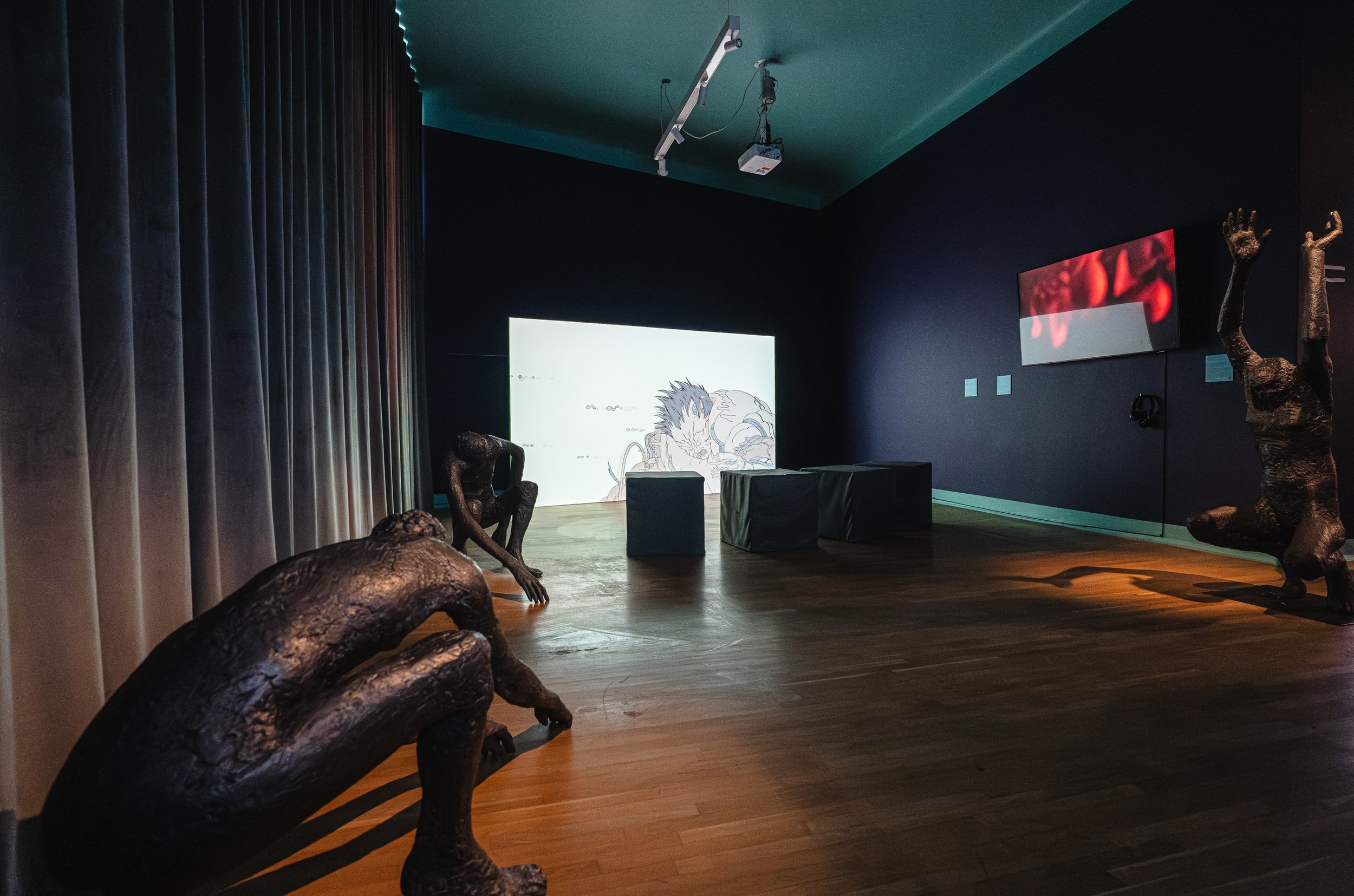
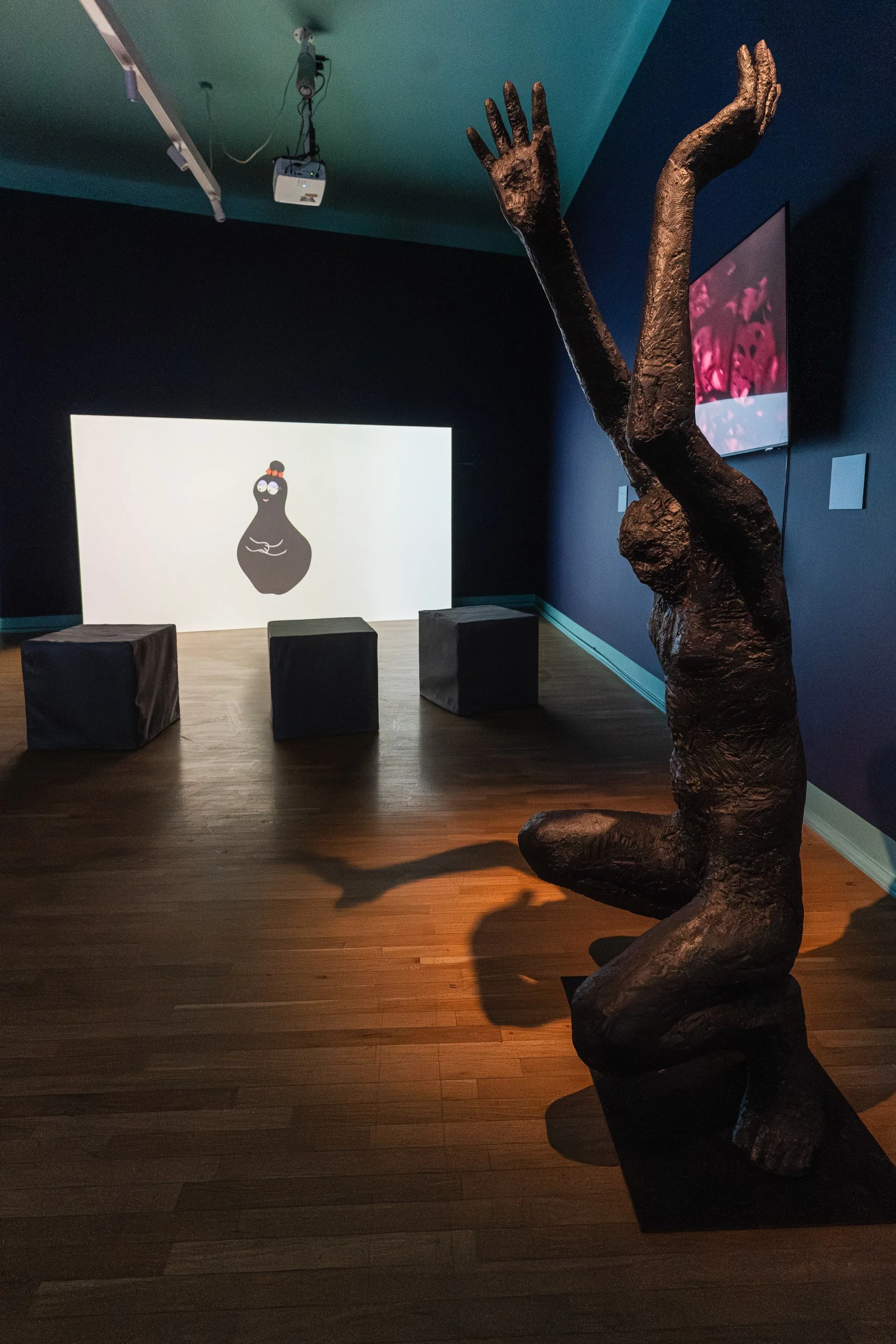
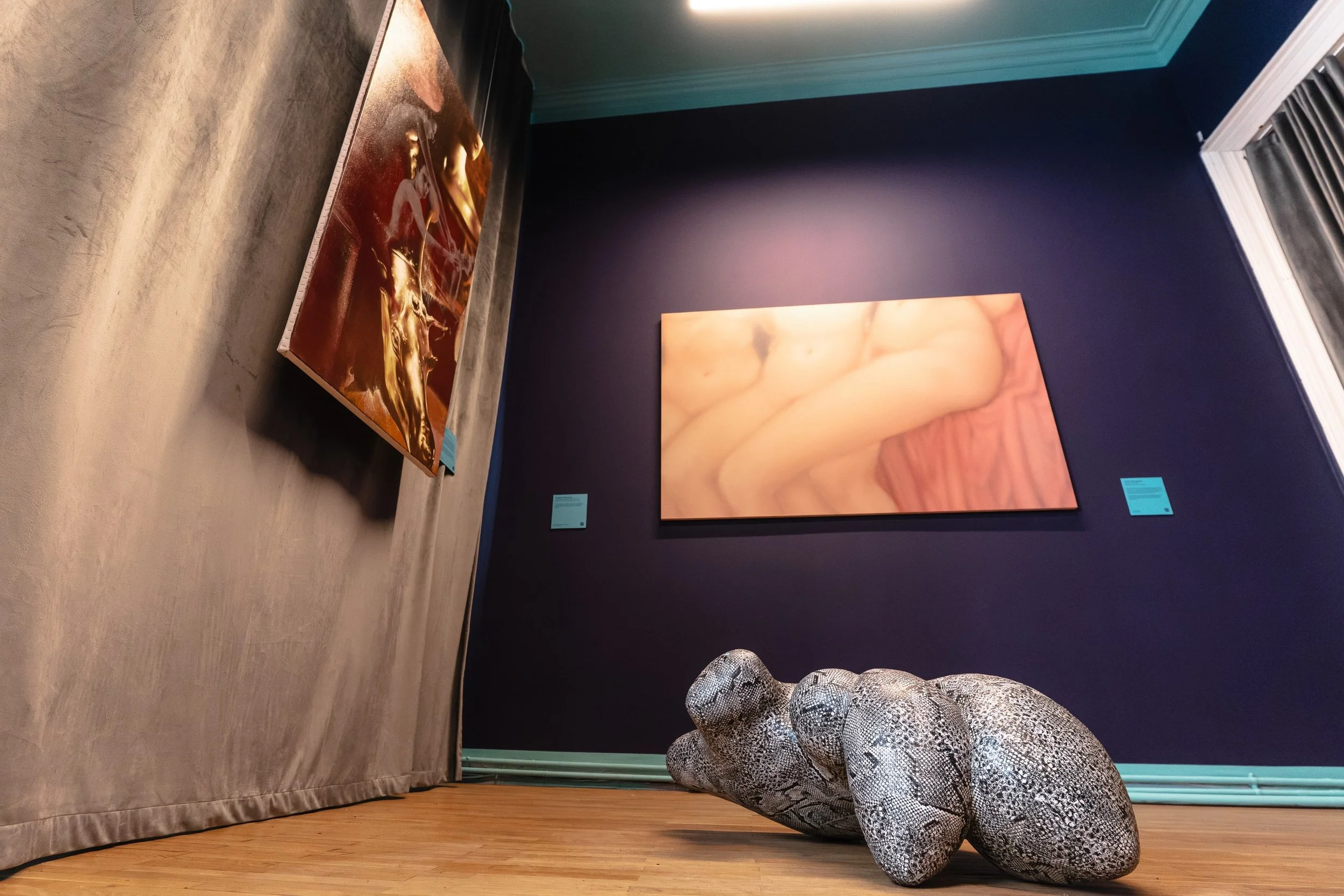
WORKS AND ARTISTS
Hoda Afshar
Undone, 2022
One-channel digital video, colour, sound, 11 minutes.
Producer and Editor: Hoda Afshar
Colourist: Peter Hatzipavlis
Sound Design: Hoda Afshar and Byron Dean
Work description:
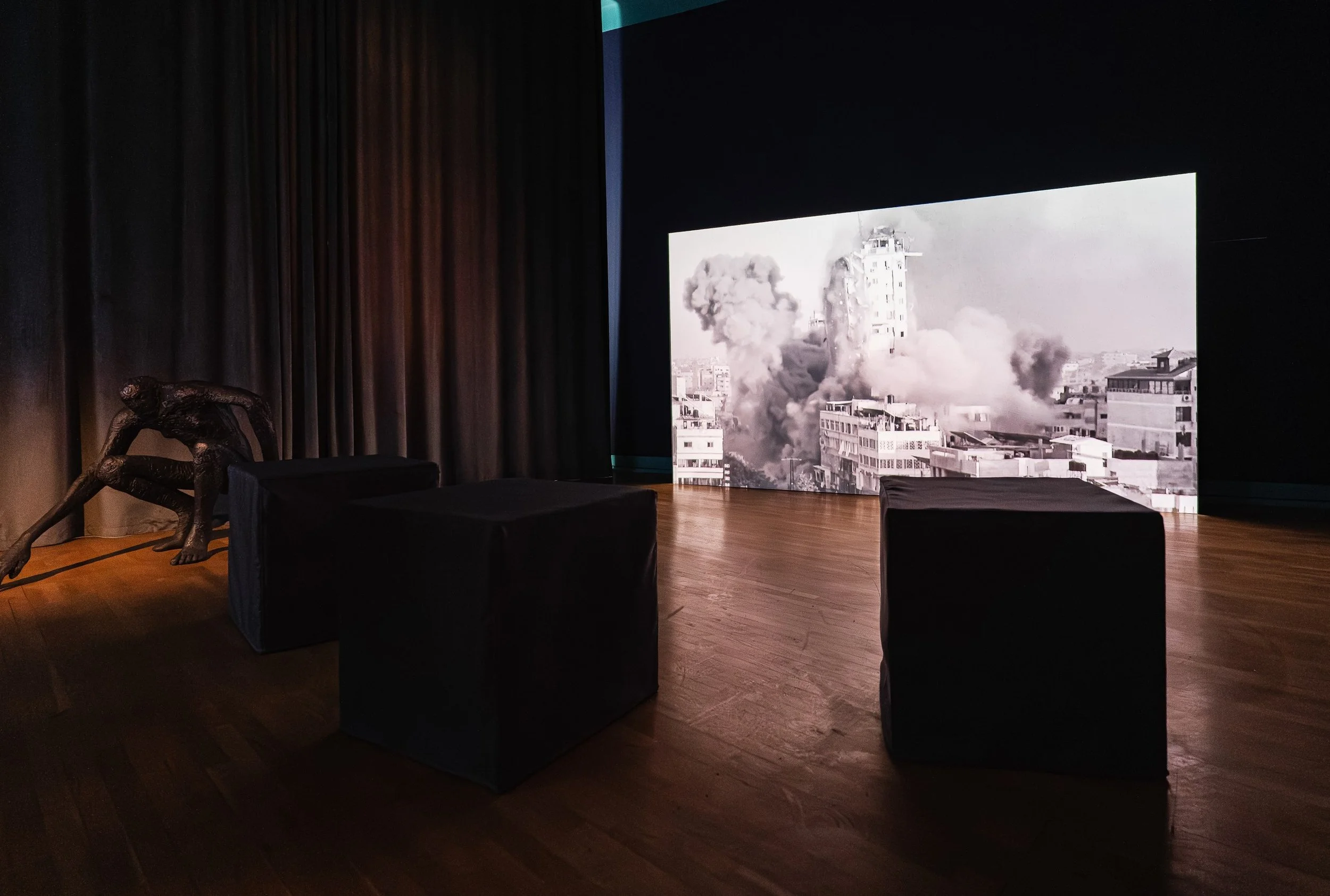
Undone is a one-channel video work, made up of found footage of bombings: of Ukraine by Russia, Palestine and Syria by Israel, Afghanistan and Iraq by the United States. By zooming into and rewinding the footage, Afshar aborts the attacks and deflates the violent consequences of armed conflicts, while the layered soundscape– from an anxious heartbeat to a dying pulse – places humanity in an atmosphere of chaos. Undone imagines the possibility of ‘undoing’ the acts of violence that continue to mark our present moment.
Bio
Hoda Afshar is a visual artist whose practice focuses on the intricate relationships between politics and aesthetics, knowledge and representation, visibility and violence. She is interested in the ways that image-making can either reinforce or challenge our common sense, and the forces that shape perception. Her works invite audiences to reflect on and to rethink how and what we see, often by drawing attention to parts of the political and visible order that have previously been excluded.
Hoda’s artistic practice embraces a variety of media and approaches – primarily using photography and video, though her recent projects have involved working with archival images and other materials including text and sound elements. She has employed diverse techniques ranging from 3D photography and printing to mirror-making, and her documentary projects often involve collaborating with participants, and other forms of intervention that disrupt traditional approaches.
Hoda’s work has been widely exhibited and published online and in print, and is part of numerous private and public collections. Throughout her career, Hoda has received numerous prestigious art awards and prizes, and is currently completing a one-year fellowship as part of the DAAD Artist-in-Berlin Program 2025. Her first monograph, Speak the Wind, was published by MACK in London in 2021. Her second monograph, The Fold, was published by Loose Joints in 2025. She is represented by Milani Gallery in Brisbane, Australia.
Cecilia Bengolea
Works:
Lightning Dance investigates the influence of electric weather on bodily imagination. It features Craig Black Eagle, Oshane Overload-Skankaz and their respective teams, in company of the artist, perform solo and group dance routines while heavy rain falls. As the dancers take center stage, their movements refer to popular Jamaican dancehall, a highly sexualized dance style, which Cecilia Bengolea sees as infused with magical healing powers. The unapologetically rough setting of the piece in combination with its illuminating effect, reinforced by the black-and-white aesthetics, highlight the dynamic gestures of the performers captivating the gaze of the viewer, while the sounds of thunderstorm become the beats to which the choreography is synched. The only trace left of dancehall music is the low-frequency base in the background, amplified by the intensity of the choreography. By dissolving the boundaries between the nature and the human, Lightning Dance captivates the viewer to the point of channeling life through movement and light.
Lightning dance, 2018
Video black and white, sound
6:30 minutes
Collection Pinault, Collection of TBA21, Tank Shanghai, Kadist
France
I 600 fili Spin and break free, 2026
Video Super 8, sound
16:00 minutes
In I 600 fili spin and break free, Cecilia Bengolea explores the industrial world of a flax yarn factory through the delicate lens of Super 8 film. The grain of the image softens the harshness of the machines, revealing an unexpected poetry : one of repetitive, almost choreographic mechanical gestures.
At the heart of this space, dance emerges as an organic echo. Bodies dressed in linen inhabit the site, forming circles and circular movements that engage in dialogue with industrial rhythms. The dancers extend the cadence of the machines while infusing it with a sensitive, living presence. Between vegetal matter and mechanical process, the work weaves a subtle connection between nature and industry.
True to her practice, Cecilia Bengolea situates the body within a broader ecosystem, where flax, a transformed natural fiber, becomes at once subject, texture, and language. Dance, like the machine, spins, turns, and reveals itself through the repetition of gesture.
Bio
Cecilia Bengolea (Buenos Aires, 1979) is an artist working across performance, video, sculpture, and dance. Her practice explores the body, individually and collectively, as a medium of memory, empathy, and emotional exchange. Using movement as a form of animated sculpture, she conceives dance and performance as sites where symbolic, social, and natural energies converge, with her own body often positioned as both subject and object.
She has collaborated with artists such as Dominique Gonzalez-Foerster, Jeremy Deller, and numerous dancehall performers such as Craig Black Eagle and Oshane Overload. Her choregraphic work in collaboration with François Chaignaud was awarded by the Prix de la Critique (Paris, 2010) and recieved the Young Artist Prize at the Gwangju Biennial (2014). Bengolea has been commissioned choreographic pieces by Ballet de Marseille, Ballet de Lyon, Ballet de Lorraine, and Pina Bausch Tanztheater Wuppertal.
Bengolea’s work has been exhibited internationally at venues including the Guggenheim Bilbao, Centre Pompidou, Tate Modern, Palais de Tokyo, Dia Art Foundation, Bourse de Commerce – Collection Pinault, Museo Reina Sofía, MUDAM Luxembourg, Art Basel Parcours, Desert X, and the Gwangju and São Paulo Biennials, among many others.
Her work is held in major public and private collections worldwide.
Julius Von Bismarck, Punishment #6
Credits:
Julius Von Bismarck, Punishment #6, 2011, Courtesy the artist; alexander levy, Berlin; Sies + Höke, Düsseldorf; Esther Schipper, Berlin, Paris, Seoul © Julius von Bismarck; VG Bild-Kunst, Bonn 2026
Description:
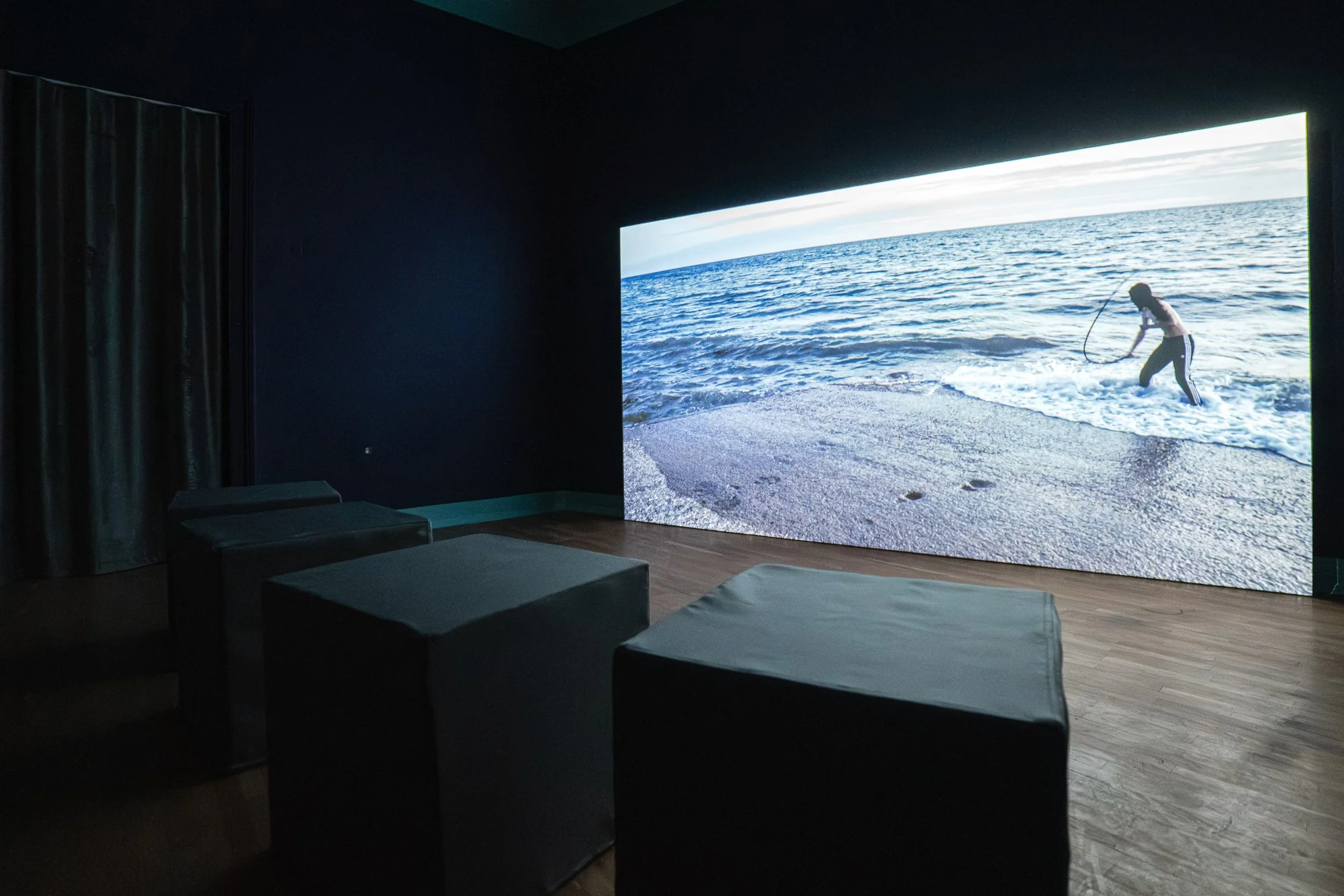
For his series Punishment (2011-2012), Julius von Bismarck traveled to the mountains of Switzerland, Brazil and the United States to battle against natural elements by whipping specific landscapes—a simultaneously enraged and meditative action which he captured in photographs and films. The settings in the Punishment series call to mind the landscape depictions of Romanticism: craggy mountains, deep gorges, the sea, and mountain lakes. These are large-format, classical motifs of nature, in which we see a young man energetically whipping a small piece of the majestic landscape to the point of physical exhaustion. The artist and his whip are dwarfed by the powerful background. The idea for the Punishment series is based on a story from 480 BC, when the Persian king Xerxes had two pontoon bridges built to enable his army to cross the Hellespont. However, the bridges, which were held by ropes of papyrus and flax, were destroyed in a storm. Xerxes ordered the two constructors to be beheaded, but, still not satisfied, he also had the sea itself, representative of Poseidon, the god of the sea, whipped with three hundred lashes as punishment. It is a futile notion to think that one can control or influence nature.
Bio
Julius von Bismarck, born 1983 in Breisach am Rhein, Germany, grew up in Riyadh, Saudi Arabia. He currently lives and works in Berlin and in Switzerland.
The artist studied at the Berlin University of the Arts (2005-2013) and the Hunter College, New York (2007). Julius von Bismarck received the Award of the Shifting Foundation, Beverly Hills (2018); IBB Photography Award, IBB Atrium, Berllin (2013); and Prix Ars Electronica Award, Linz (2009), among others.
Spanning a wide range of forms-from kinetic sculptures and photographs to video installations and landscapes-Julius von Bismarck's work is produced in an intense engagement with the world and the physical conditions that determine existence on the planet. His work treats the natural world as a laboratory, a studio or sometimes even as a kind of canvas. Employing optical illusion, elaborate tromp l'oeil or incongruous action, his works can confound viewers, allowing them to experience the world and their place in it from a reoriented perspective. At the core of his practice is the question of how the notion of Nature was constructed: specifically, how the conceptual split stipulated by man from his surroundings, through naming, classifying and creating systems, has gone hand in hand with control and domination of the environment, to increasingly disastrous effects, not just for nature itself but as a consequence of wider notions of humanity's sovereignty, also for the lives of other beings, human and non-human.
Ambitious and expansive, von Bismarck's projects are rooted in extensive research and experimentation to invent entirely new technological apparatuses that articulate and give form to his ideas. At times grandiose or granular, the works beguile with their originality of thought and execution. Playing on danger-real and implied existential risks for the artist, or his team, for example, by triggering lightning with small rockets, or for the audience who are placed near slowly collapsing sculptures or confronted with what appear to be large quantities of precariously suspended explosives-von Bismarck's projects reveal an explorer's adventurousness, tempered by a scientific approach and the artist's profound self-awareness of his engagement with the operations of a flawed Enlightenment that his work seeks to critique.
Monica Bonvicini. Anger is like
Monica Bonvicini
Anger is Like
2019
tempera on Fabriano paper / Tempera auf Fabriano Papier
Framed 219 x 167 x 5 cm [HxWxD] (86 ⁄ " x 65 3⁄ " x 1 31⁄ ") 7 32 4 32
200 x 150 cm [HxW] (78 3⁄ " x 59 1⁄ ") 4 16
Anger Drawings
Courtesy of the artist and Galerie Gisela Capitain, Cologne
Bio
Monica Bonvicini emerged as a visual artist and started exhibiting internationally in the mid-1990s. Her multifaceted practice investigates the relationship between architecture, power structures, gender and space. Her research is translated into works that question the meaning of making art, the ambiguity of language, and the limits and possibilities connected to the ideal of freedom. Dry-humored, direct, and imbued with historical, political and social references, Bonvicini’s art never refrains from establishing a critical connection with the sites where it is exhibited, its materials, and the roles of spectator and creator. Since her first solo exhibition at the California Institute of the Arts in 1991, her approach has formally evolved over the years without betraying its analytical force and inclination to challenge the viewer’s perspective while taking hefty sideswipes at patriarchal, socio-cultural conventions
Description:
Known for her daring exploration of space, power, and identity, Monica Bonvicini stands as an important figure in the contemporary art landscape. With a career spanning over three decades, Bonvicini's work embodies a profound dialogue between architecture, gender, and social constructs.
Monica Bonvicini’s 2019 Anger is Like is a powerful reflection of her exploration into literature and poetry, focusing on influential female writers and figures. Bonvicini recognises “anger” as a historically significant tool when discussing feminist and civil rights movements. Using language and space in Anger is Like, this work portrays femininity and feminism, challenging conventional narratives surrounding women, rage and contemporary global politics.
“Bitterness is like cancer. It eats upon the host. But anger is like fire. It burns it all clean.” Maya Angelou
Aukje Dekker. Life is a ride
Video + mindmap
3A. LIFE IS A RIDE
This mindmap shows how Life is A Ride came into being and is an integral part of the work.
2023
Mindmap
Dimensions: Matching the exhibition label
3B. LIFE IS A RIDE
A portrait of a one off unpracticed synchronized swimming collective formerly known as individuals, accompanied by a band that never played together before, directed by no one, for the first time ever, straight away live without edits, rehearsal or water. One weird set up and no instructions aka life as we know it.
2023
Video
Dimensions: HD 4:3
Duration: 51.49 (loop)
Textul de credits:
Aukje Dekker x Anna Dekker x Janneke Remmers x Lonneke van der Palen x Nelke Mast x Oscar Jan Hoogland x Jasmine Karimova x Maarten van der Kamp x Thomas van Krugten x David Moir x Berend Holtkamp x Paul Dubois Reymond x Vava Stojadinovic x Isa Grutter x Noa Jansma x Jordi Ariza Gallego x Liza Nijhuis x Rocco x Kristian de la Riva x Vincent Rietveld x Wendela Scheltema x Laurie Cluitmans x Heske ten Cate x voltallig Full Circle publiek Felix Meritus x Aafke Bouman x Gijs Frieling x Cleo Campert x Joost Janmaat x Reem Saouma x Dim Balsem x Anouk Kamminga x Jan Hoek x Willem Mertens x Jasper van de Berg x Frederiek Biemans x Appie Bood x Carole van Ditzhuyzen x General Idea x John Baldessari x Lijs Dekker x Nina Winterink x Garderen x Waynehorse x Leen van Leen x Maurice Scheltens
LIFE IS A RIDE
Bio
Aukje Dekker (Rotterdam 1983) is a visual artist that works through collaboration as both method and worldview. With humor and self-mockery she questions hierarchy, autonomy and significance. From the Eddie the Eagle Museum to the children’s art series Moonriders (VPRO) or experimental nightclub SEXYLAND World, her work ranges through a whole lot of fields and consistently destabilizes ownership and control. Dekker graduated with honors from the Gerrit Rietveld Academy (BA) and finished her masters at Sandberg Institute (MFA) and Central St Martins London (MFA).She exhibits nationally and internationally. Recently she and husband wilderness guide Kristian de la Riva moved to Northern Spain for their newest project; Art & Wildlife hotel ‘ORKESTRA’, where she explores the most complex and proven model of collaboration we know: nature.
C. B. Evans. RECEPTION! and MEMORY!; Reality or Not
Works:
Reality or Not, 2023, video, 35 min.
MEMORY!, 2025, video, 3 min.
RECEPTION!, 2024, video, 2 min.
Descriptions:
RECEPTION! and MEMORY! act as proof of concept videos for the full length version of Reception!. They are character studies of the main character and her double, a memory that has abandoned Reception's body. Both live in a world where an ecological crisis has forced a storage shortage, leading to the loss of much of the population's personal data. Reception is one of the last human translators in this world, working to transcribe recovered memories for an organization created by the corporation that caused the catastrophe. Her own memory, considered an autonomous agent, struggles under the strain of a body entangled in the system that led to the disaster.
Reality or Not follows a group of high school students from a suburb north of Paris who are invited by an American producer to participate in a reality TV show only to reject their own reality. Their story of radicalization is encouraged by the Producer (Evans) and narrated by their former teacher (Alexandra Stewart) as the students begin a practice of world jumping that moves the film across disparate realities.
Alongside this group of young people, an eclectic array of characters construct interwoven storylines ranging from a former Real Housewives star turned hacker who attempts to take down the International Monetary Fund to a group of failed renders of a virtual influencer that unite to form a workers collective.
The 35-minute film is lodged with penetrating humor to deliver cutting overviews of contemporary culture and seductive images that play a vital foil to the assault of ideas, luring audiences magnetically into the realities unfolding. "No you, no me, no storylines”.
Bio
ENGLISH SUPER SHORT:
Cécile B. Evans lives & works in Saint Denis. They have previously exhibited at Centre Pompidou, Tate Liverpool, Lafayette Anticipations, Whitechapel Gallery, Haus der Kunst, & Singapore Art Museum- amongst others. In 2024 they were invited for a special project by Miu Miu and in 2025 they were commissioned for a site specific installation for the 16th Sharjah Biennale. Evans’ films have been screened in festivals such as the New York Film Festival and Rotterdam International. Evans’ work is held in public collections like MoMA NY, the Whitney Museum, Centre Pompidou, Louisiana Museum of Modern Art, and the National Museum of Art Seoul.
ENGLISH SHORT:
C. B. Evans is an American-Belgian artist living and working in Saint Denis. Evans’ work examines the value of emotion and its rebellion as it comes into contact with ideological, physical, and technological structures. In 2024 they were invited for a special project by Miu Miu and in 2025 they were commissioned for a site specific installation for the 16th Sharjah Biennale. They have previously realized new commissions at Centre Pompidou (FR), Museo d’Arte Moderne di Bologna (IT), Tate Liverpool (UK), Lafayette Anticipations (FR), Tramway (UK), Serpentine Galleries (UK), Castello di Rivoli (IT), Museum Abteiberg (DE), Berlin Biennale (DE), Sydney Biennale (AU), and exhibited work at High Line (US), Whitechapel Gallery (UK), Haus der Kunst (DE), Renaissance Society Chicago (US), Singapore Art Museum, Mito Art Tower (JP) amongst others. Evans’ films have been screened in festivals such as the New York Film Festival and Rotterdam International. Evans’ work is held in public collections such as MoMA NY (US), the Whitney Museum (US), Centre Pompidou (FR), Louisiana Museum of Modern Art (DK), and the National Museum of Modern and Contemporary Art Seoul (Sk).
Aristotle Forrester. Concrete Visionary & Under the Sky, A Blue Procession
Concrete Visionary
2023
oil on canvas
68 x 55 inch
Under the Sky, A Blue Procession
2023
oil on canvas
68 x 55 inch
Courtesy of the artist
Concrete visionary
A canvas created through print making, collage, oil painting, and drawing examines the sensation of a city, echoes of ancestors that created and lived within it and the juxtaposition against a sky vaulted above concrete towers. There is a perspective of looking out over a skyscraper from the roof of another, looking down on the streets below, a visionary perspective that allows one to feel the scale of the city. Abstract mark making builds a structural composition, capturing the energy and climate of wind and people bustling through high rise buildings.
Text is interwoven throughout the piece, representing the constant text of advertisement, thought and conversation experienced in urban environments. The vernacular of the city holds a character of New York: deep, rooted, concrete pillars, constructed of generations of diverse classes, cultures and perspectives piercing up into a sky, large enough to hold the colossal expanse.
Under the Sky: A Blue Procession
An abstracted city landscape embodying the sensation of the sky meeting buildings. Two brothers look down on the commotion below: an endless battle between the people and the forces represented by mounted riders. The language of the space is quiet, contemplating operating systems of concrete spaces. This piece references the allegory of cathedrals as legal spaces and jurisdictional elements of society play within the cloud work, embodying a sense of paranoia, and allowing these images to slip with and through each other, abstractly creating the evaporative space around the grounded concrete rooftops upon which the brothers sit and spectate their city, finding space for themselves on the concrete.
Bio:
Aristotle Forrester is a painter and printmaker whose work focuses on ancestral storytelling and the congruencies between the figure and landscape. His work relies on the use of his body and color to make gestural marks that animate perspective and create worlds of movement. As a black artist navigating the intersections of personal and collective history, he draws inspiration from the Yoruba and Afro-Caribbean spiritual landscape and palette, Jack Whitten’s use of self-made tools and paint to push the boundaries of abstract mark-making, and the depictions of external space, internal landscape and power structures invoked in Renaissance painting and printmaking.
Intertwining his traditional training with the diasporic origins of his ancestors, Forrester combines cultural symbols and processes to create images that expand the definition of abstraction to include his life perspective. Forrester’s images span a lattice of material and process. Leveraging hand-made paint from non-traditional pigments, printmaking techniques, textiles and collage, he creates images that expand painting’s lineage of conversation.
Forrester is based in New York. He received his Bachelor of Fine Art degree from the Massachusetts College of Art and Design in 2016 and his Master of Fine Art from Columbia University, New York in 2024. Forrester is currently an artist in residence at Silver Art Projects in New York. Recent exhibitions include such venues as Untitled Art Fair (Miami), Frevo (New York), [CONTAINER] (Santa Fe), LatchKey Gallery (New York), Thierry Goldberg (New York), Frederic Snitzer (Miami), Storage Gallery (New York), M Fine Arts Galerie (Boston), the Inside Out Museum (Beijing), the Obama Foundation Democracy Forum (New York). His work can be found in the permanent collection of Harvard University (Boston).
Fronte Vacuo
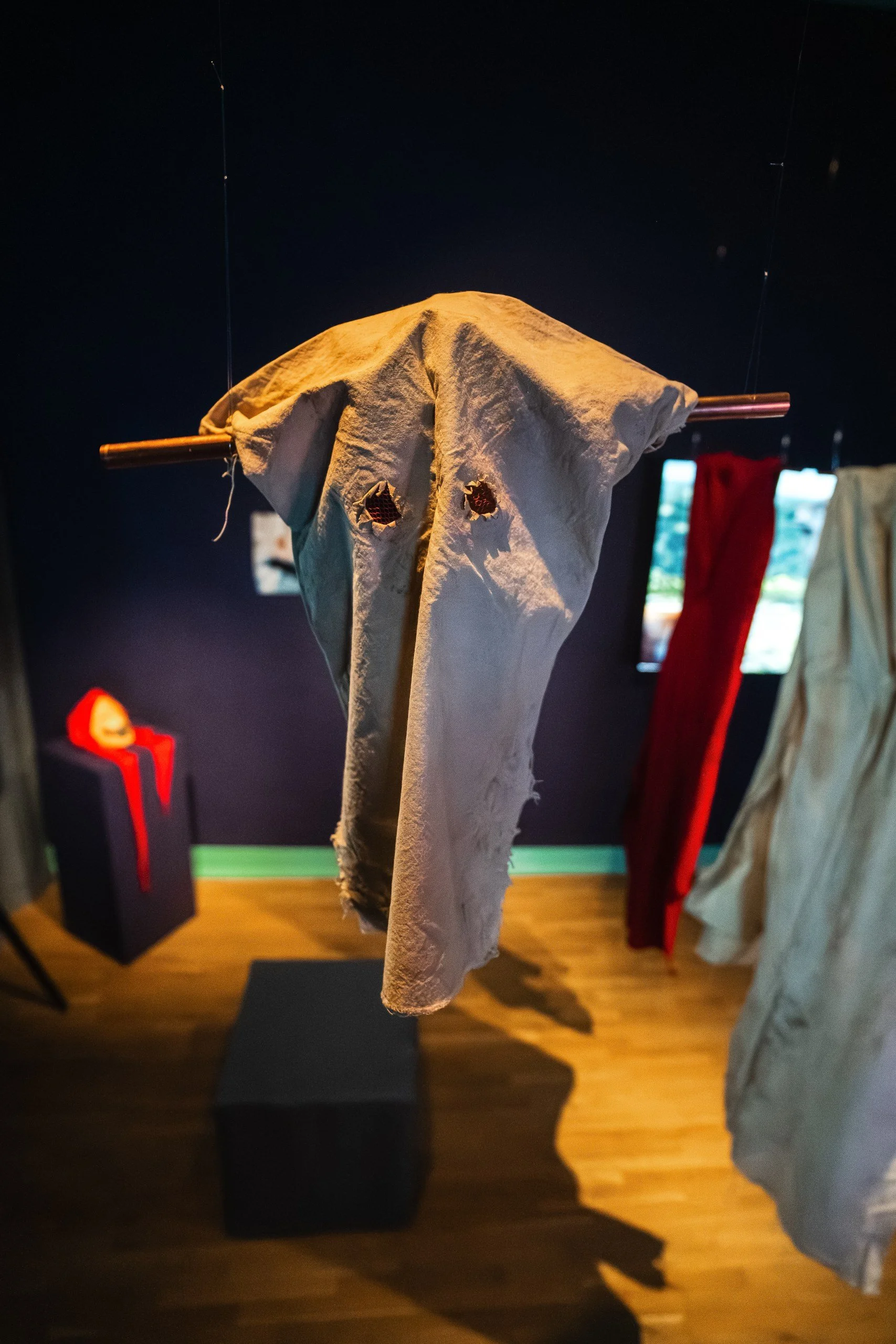
Costume and mask for the character “Officiant”
2020
Mixed media (red cotton, ivy branch, acrylic paint)
From the performance ℧R
Courtesy of the artist
Costumes for the characters “White Hoodies” and set objects
2019-2022
Mixed media (white cotton, acrylic paint, Physarum polycephalum, rubber, metal jug)
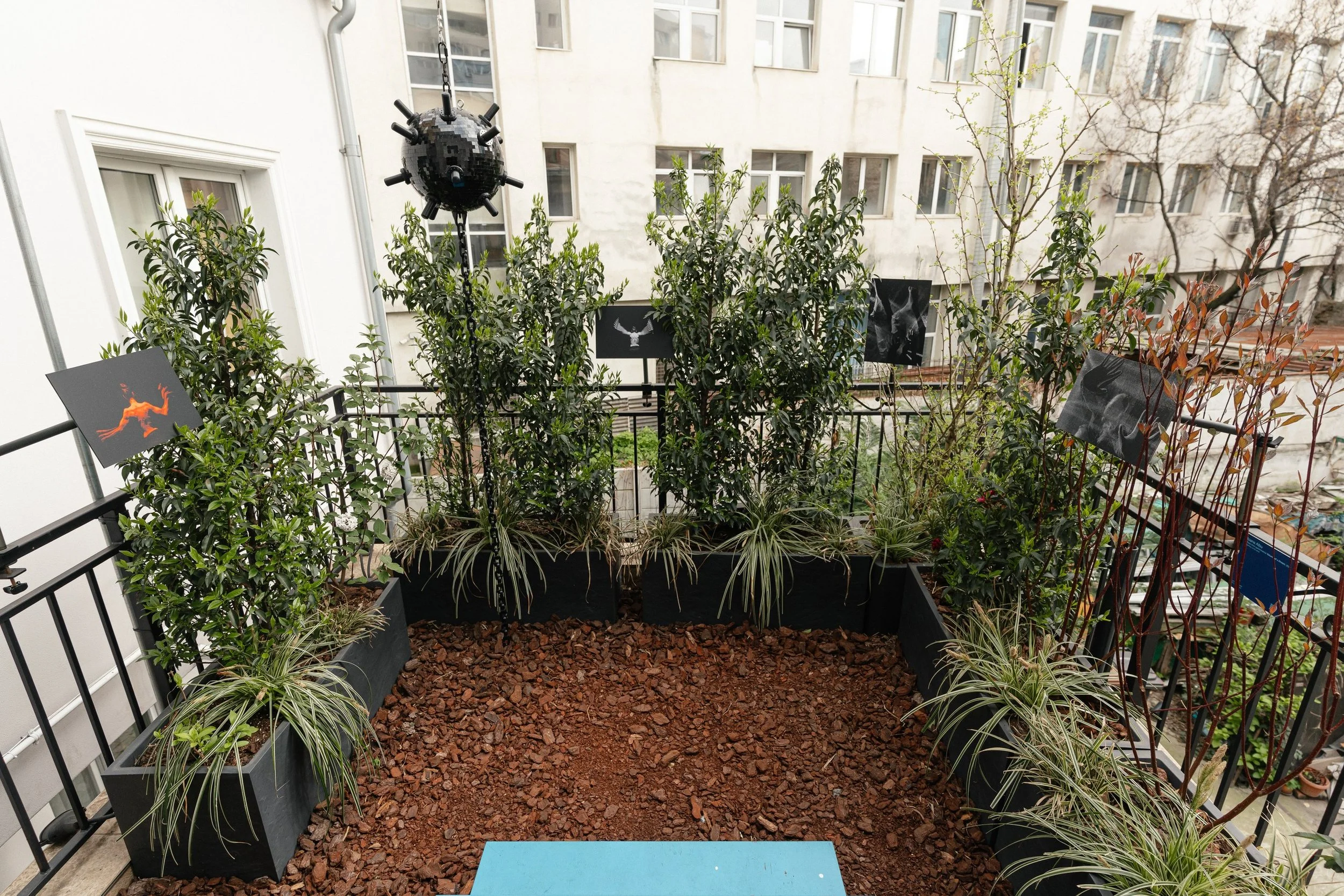
From the performances ΔNFANG and ΣXHALE
Courtesy of the artist
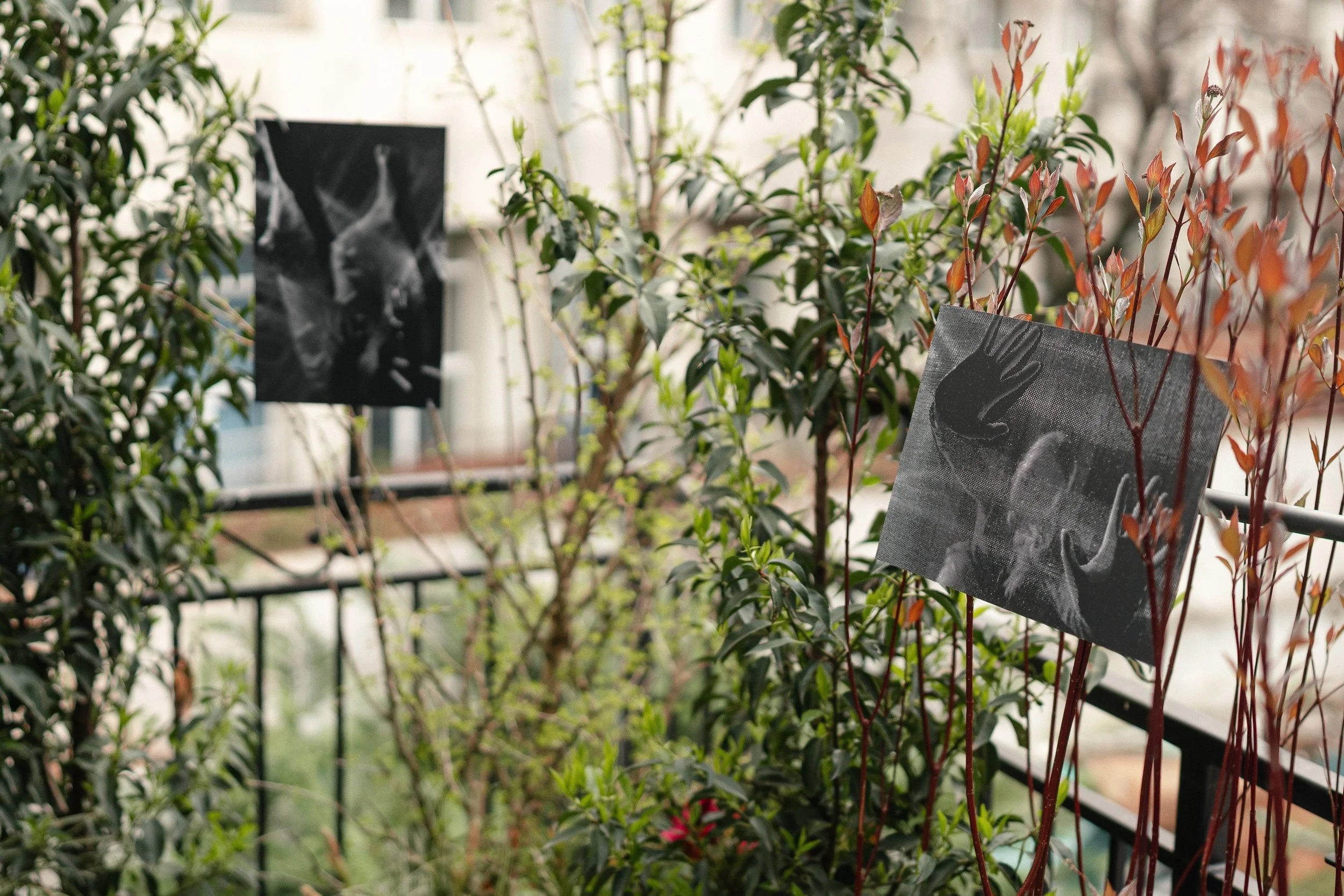
ΣXHALE: The Sleep
2022
Photographer: Margherita Pevere
Medium: dibond
Dimensions: 45 x 30 cm
Courtesy of the artist
MμRMUR: The Deer
2024
Photographer: Nikolaus Ostermann
Medium: dibond
Dimensions: 45 x 30 cm
Courtesy of Nikolaus Ostermann and the artist
¦MPOSSIBILITY: Children of the Oracle
2023
Nikolaus Ostermann
Medium: dibond
Dimensions: 45 x 30 cm
Courtesy of Nikolaus Ostermann and the artist
Ex Silens: New Organs
Marco Donnarumma and Manuel Vason
2024
Medium: dibond
Dimensions: 45 x 30 cm
Courtesy of the artists
℧R: Theater of Annihilation
2020
Single-channel HD video, color, sound
02:56 min
Courtesy of the artist
ΣXHALE: The Cage
2026
Single-channel HD video, color, sound
04:53 min
Courtesy of the artist
ΣXHALE: The March
2026
Single-channel HD video, color, sound
06:56 min
Courtesy of the artist
Bio
Fronte Vacuo is a transdisciplinary duo run by Marco Donnarumma and Margherita Pevere. Their radical performances from the ongoing saga Humane Methods redefine contemporary live art through a distinctive symbolism where sound, movement, audience participation, living materials and emerging technologies combine into evocative experiences.
Known internationally for her otherworldly work with living matter, ecology and biotechnology, Margherita Pevere is an artist and researcher addressing taboos like death, sex and vulnerability. Her work extends beyond the arts through high-profile art and science collaborations across academia and society.
Marco Donnarumma is an artist, inventor and theorist. His oeuvre confronts normative body politics with uncompromising counter-narratives, where bodies are in tension between control and agency, grace and monstrosity. He is best known for using sound, AI, biosensors, and robotics to turn the body into a site of resistance and transformation.
Text pentru toate lucrările
Fronte Vacuo presents three video artworks inspired by the group’s performances ℧R and ΣXHALE. The performances are part of an ongoing series entitled Humane Methods, the saga of a broken, future society seeking how to respectfully coexist with nature and technology, oscillating between new forms of algorithmic violence and posthuman empathy. The stories of this fictional society become stage productions, street performances and hybrid live installations where audiences live hyper-real science fiction scenarios.
The video artworks take live footage recorded during the performances and reinterpret the material in the form of self-enclosed, yet interconnected allegories. A reflection on empathy, violence, communal action and power structures weaves a thread across the three works. By observing the almost human characters struggle to exist in a world where mysticism, ritual and dynamics of dominance play into each other, the parallels with the contemporary state of the world begin to unfold.
Xenia Hausner. Distant Voices.
Distant Voices, 2024
Oil and acrylic on 300g Fabiano rag paper on Dibond,
127 x 149.5 cm.
Courtesy of the artist
Bio
Xenia Hausner, an internationally established artist, painter, and stage designer centres her work on the female perspective. Her powerful, multilayered, and often contradictory female figures stand as symbols of universal conditions and existential questions. Her women speak of identity, of closeness and distance, of connection and alienation. Hausner’s work is a feminist statement – a call to confront the open-ended questions of femininity, social roles, and the power of the female gaze.
Hausner’s works have been shown at galleries, art fairs and museums such as Albertina Vienna; Museum Franz Gertsch Burgdorf; Elbphilharmonie Hamburg; Batliner Art Foundation, Belvedere Museum Vienna, Käthe-Kollwitz-Museum Berlin, Shanghai Art Museum, Today Art Museum Beijing, Hong Kong Arts Centre, Russian State Museum St. Petersburg, Museum Würth France Erstein, Würth Collection Oslo, European Central Bank Frankfurt, collateral to the 57th Venice Biennale 2017 – „Glasstress“ Palazzo Franchetti Venice; 8th Moscow Biennale, State Tretyakov Gallery; Forum Gallery New York; Bienalsur – South America’s Art Biennale 2019 – „Juntos Aparte“ Columbien. „This will have been another happy day!“ PalaisPopulaire der Sammlung Deutsche Bank Berlin 2020.
Distant Voices
Like fragments of a story, a narrative tension runs through Xenia Hausner’s works, resisting clear interpretation. What remains is the moment of encounter – the silent charge between the figures. Themes such as intimacy, loneliness, and the feeling of being alone among others are central to Hausner’s practice. In Distant Voices, this tension is particularly evident: figures are physically intertwined, their bodies close, almost entangled, as if caught in a slowed-down movement. Their gazes do not meet, each appears absorbed in a separate inner world. What appears as intimacy reveals itself as distance. The painting captures the discrepancy between physical closeness and emotional detachment - a state of being together while remaining fundamentally apart. In this contradiction, Hausner reflects a condition that extends beyond the individual, pointing towards a broader sense of disconnection within contemporary society.
Gregor Hildebrandt.
"dunkle Barta Bewegung 1", 2019
VHS tape, acrylic on canvas
229 x174 cm
helle Barta Bewegung 1, 2019
magnetic VHS tape coating, adhesive tape and acrylic on canvas 229x174 cm
Courtesy of the artist and Wentrup, Berlin
Works:
dunkle Barta Bewegung 1 and helle Barta Bewegung 1 (2019) stem from a series of six large gestural tape collages by Gregor Hildebrandt. The couple of works was made through the “Ripoff” technique invented by Hildebrandt, in which he paints on a first canvas primed in white and glued with adhesive tape with fixative. He then applies VHS or audiotape onto the surface of the canvas and transfers those tapes onto a second canvas, as well primed in white. The transfer of the tapes from one canvas to another reveals the motive primarily painted by Hildebrandt and results in two perfect negative and positive versions of this motive. The tape used for the collage is generally pre-recorded by the artist with a film or a song, which holds a strong significance for him.
In both dunkle Barta Bewegung 1 and helle Barta Bewegung 1, the brush strokes are reminiscent of the gestural approach of Abstract Expressionism and seem to encapsulate a vivid and yet very focused energy. Hildebrandt filmed himself, while painting the canvases of this series and later recorded it on the tape used to cover the canvases. Like a memory held in secret in the paintings, Hildebrandt’s artistic gesture coexists with its very outcome on the surface of the paintings, building a sort of mise-en-abyme.
Bio
Gregor Hildebrandt was born in Bad Homburg, Germany, in 1974. He currently lives and works in Berlin. He is professor for Painting and Graphics at the Academy of Fine Arts in Munich since 2015.
Hildebrandt's solo exhibitions include Blau im Gedächtnis, Perrotin, New York (2024); Gilardi Lilien, Casa Gilardi, Galería Saenger, Mexico (2024); Nah am Wasser, Kunsthalle Rostock, (2024); A Blink of an Eye and the Years are Behind Us, Kunsthalle Praha, Prague (2022); Im Sturz durch Raum und Zeit, Mies van der Rohe Haus, Berlin (2021); Luft in allen Zimmern, G2 Kunsthalle, Leipzig (2020); Der Raum ist die Miete, Almine Rech, Brussels (2019); Tönend hallt die Jugend, Kunsthalle Recklinghausen (2018); In meiner Wohnung gibt es viele Zimmer, Perrotin, New York (2018); Ein Zimmer im Raum, Wentrup, Berlin (2018); Urlaub im Urban, Künstlerhaus Bethanien, Berlin (2016); Front Room, Contemporary Art Museum St. Louis, USA (2008).
His most recent group exhibitions include Tuning in - Acoustique de l'émotion, International Red Cross and Red Crescent Museum, Geneva (2024); Re-inventing Piet. Mondrian and the Consequences, Kunstmuseum Wolfsburg (2023); Landscapes of desire, 4th Industrial Art Biennial, Croatia (2023); L'année dernière à Malmaison, Atelierele Malmaison, Bucharest (2022); Blanc de Blancs, Villa Schöningen, Potsdam (2022); Studio Berlin, Berghain, Berlin (2020); Eine Geschichte: Zeitgenössische Kunst aus dem Centre Pompidou, Haus der Kunst, Munich (2016).
Hildebrandt’s works are present in renowned collections, such as the collection of Centre Pompidou in Paris, the Contemporary Art Collection of the Federal Republic of Germany, the Martin Z. Margulies Collection in Miami and the Burger Collection in Hong Kong.
In 2018, Hildebrandt created together with his partner, the artist Alicja Kwade, the label Grzegorzki Records. Throughout his career, he has also curated numerous group exhibitions and has been running the project space Grzegorzki Shows in Berlin since 2017.
Madeline Hollander. Flatwing
Madeline Hollander
Flatwing, 2019
16:25 min
Digital HD video, Infrared Color, Sound
Courtesy the artist and Bortolami, New York
Work:
Flatwing (2019), Hollander's first video installation, explores the emergence of silent crickets in Kauai, Hawaii, and the imminent extinction of their chirping rivals. The film guides the viewer through Hollander's expedition through Kauai's cacophonous rainforest nightscape, and her futile attempt to record the movements of this elusive new species. Ventriloquizing their fellow cricket's mating chirp by silently rubbing their wings together, the trickery of the mute crickets’ movements perform a choreography of survival.
In Hollander’s own words: “The video is overlaid with audio clips from a phone conversation that took place months before the trip between myself and the scientist, Marlene Zuk, who runs the research lab studying this instance of rapid evolution. Intrigued by the idea that these silent crickets would have to develop a non-audible mating call for survival, I reached out to the lab requesting footage of their ‘silent’ chirping moves. I was shocked to discover that not only was there no footage, but no interest in acquiring it. The scientists needed data for calculating statistics and I needed visuals for developing a new choreography. Despite being repeatedly informed of the utter futility of this shoot, I booked a flight moments after hanging up the phone.”
Bio:
Madeline Hollander (b. 1986, Los Angeles, CA; lives in Los Angeles, CA) attunes to systems in movement, generating choreographies drawn from the oft-imperceptible circulation of people and matter. Initially trained as a ballet dancer, Hollander’s research-based practice culminates in a series of records—choreography, video, installation, and notational drawings—themselves dense systems of transitory information.
Solo exhibitions of Hollander’s work have been mounted at Bortolami, New York (2024); the Whitney Museum of American Art (2021); the University of Texas at Austin, Visual Arts Center (2020); The Artist’s Institute, New York (2018). Her work has been exhibited at the Brandhorst Museum, Munich, Germany (2022); Centre Pompidou Metz, France (2019); and the 2019 Whitney Biennial.
As a choreographer, Hollander’s pieces have been performed at ICA San Francisco; Metropolitan Museum of Art, New York; ICA Boston; the Joyce, New York; The Théâtre des Champs-Elysées, Paris, and Louvre Abu Dhabi with the Los Angeles Dance Project. She has collaborated with Jordan Peele on his feature film Us (2019); Urs Fisher’s immersive installation PLAY at Gagosian, New York (2019); and Jeffrey Deitch, Los Angeles, CA (2019).
Anne Imhof
Untitled (Wave), 2021
Video, Color, Sound
30:19 min
Featuring Eliza Douglas
Directed by Jean-René Étienne and Lola Raban-Oliva
Music by Eliza Douglas
© Anne Imhof
Courtesy the artist, Sprüth Magers
BIo:
Anne Imhof (*1978) has emerged over the past decade as one of the most acclaimed artists of her generation. Today based between Berlin and New York, Imhof spent her formative years in Frankfurt am Main, where she taught herself to draw and make music while working as a bouncer at a local night club.
Imhof’s practice has since evolved to encompass performance and choreography, painting and drawing, music, installation and sculpture. While her work is inherently multifaceted and continues to expand into ever more media, such as, most recently, film, Imhof conceives her art-making from the vantage point of painting. Her poignant abstractions, whether composed as performance, as two-dimensional images, or in the form of sculpted and found objects, are distinguished by her mastery of perspective and framing. This approach also manifests in her treatment of bodies as gestural surfaces, the positioning and posture of her figures, as well as her distinct symbolism and use of color. Imhof is a maker of pictures, whose images, moving or stilled, point to the history of painting as much as to the fetishes of contemporary commodity culture.
Imhof’s performances, correspondingly, have been described as tableaux vivants. When their liveness fades away, her pictures turn natures mortes and reveal marks of a vampiristic melancholy that accompanies the artist’s undeadening procedures of transforming life into image and vice versa. In this, she is joined by a community of friends, dancers, artists, musicians, poets, and models, who cohabitate alongside the audience within her epic durational installations and animate them through their movement, singing, and ghostly presence of studied passivity. Though following a notated score, the dark play of their ritualistic actions—frequently involving bodies walking in slow motion, spilling fluids, falling, carrying each other or hanging out—is ruled by the contingencies of collaboration and directed by the artist in real time.
Barbara Kapusta. Leaky Things
Installation details:
Damp Being, 2020
brown clay, transparent glaze, platinum lustre, 45 x 13,5 x 10,5 cm
Open Body, 2020
clay, porcelain, black pigment, transparent glaze,
platinum lustre, 29 x 22 x 14,5 cm
Anxiously Leaking, 2020,
porcelain, red iron oxide, transparent glaze, platinum lustre, 24,5 x
16,5 x 9,5
Absorbing Body, 2020
brown clay, platinum lustre
34 x 30,5 x 15 cm
Leaking Body, 2020
red clay, transparent glaze, platinum lustre
34 x 22,5 x 10,5 cm
Courtesy of the artist
Description
Being permeable bodies, techno-bodies, we stress and fight the effects of politics, medicine, and ecological disaster. We become contaminated and contaminate ourselves. We leak. Ours is a tale of a promiscuous desire, for a borderless being, of opening up and letting things pass and the obstacles put in our way. Our skin here assumes the position of a zone of transition, as a membrane it allows permeability and movement between two systems functioning as a separation and connection at the same time. It is a fertile zone where transformations occur, new compositions and multiplications. At the same time, there is a constant and real threat of pollution, extinction, poisoning deriving from capitalism, consumerism, our very own actions. What is being spread?, Kapusta asks and also means something collective, oozing, something that can be shared and spread without danger.
Bio
Barbara Kapusta (born 1983, lives and works in Vienna) is a writer and artist who in her works interconnects human bodies with the language of the digital world. Her texts are literary fiction that, in the form of fragments or whole stories, penetrate into artists’ publications, performances, film works and object installations on the border between physical and virtual environments. Central, recurring themes in her practice are technology, ecological concerns, the vulnerability of the body and the community, and the way history is intertwined with our present.
Recent exhibitions include Shedhalle, Zürich (2026) Unsere Zukunft wird eine weitere Gegenwart gewesen sein, museum moderner kunst stiftung ludwig wien, Vienna (2025); Polyphony Is Us, maltabiennale (2024), UNKNOWN FAMILIARS, Leopold Museum, Vienna (2024); Fragiles, Klosterruine Berlin (2023), WORDS DON’T GO THERE, Kunstverein Braunschweig (2023): The Palace of Concrete Poetry, Writers’ House, Tbilisi, (2022); Let your () do the talking, NAK Aachen (2022); Futures, Kunsthalle Bratislava (2022); Lo(l) – Embodied Language, Kunsthaus Hamburg (2022).
In 2023 she received the Media Art Prize of the City of Vienna, in 2020 the Otto Mauer Prize. Since 2021 she is a board member of the Vienna Secession.
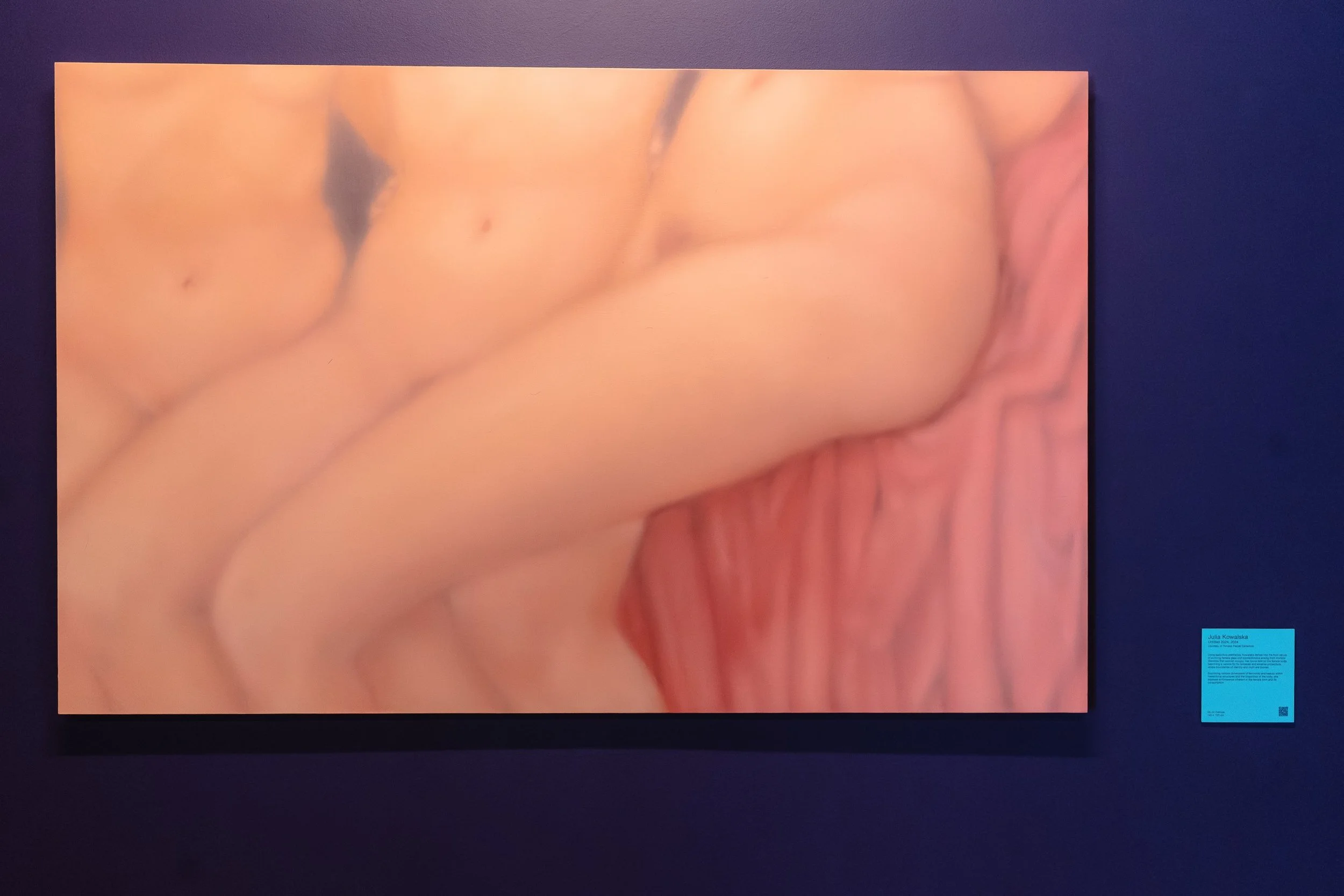
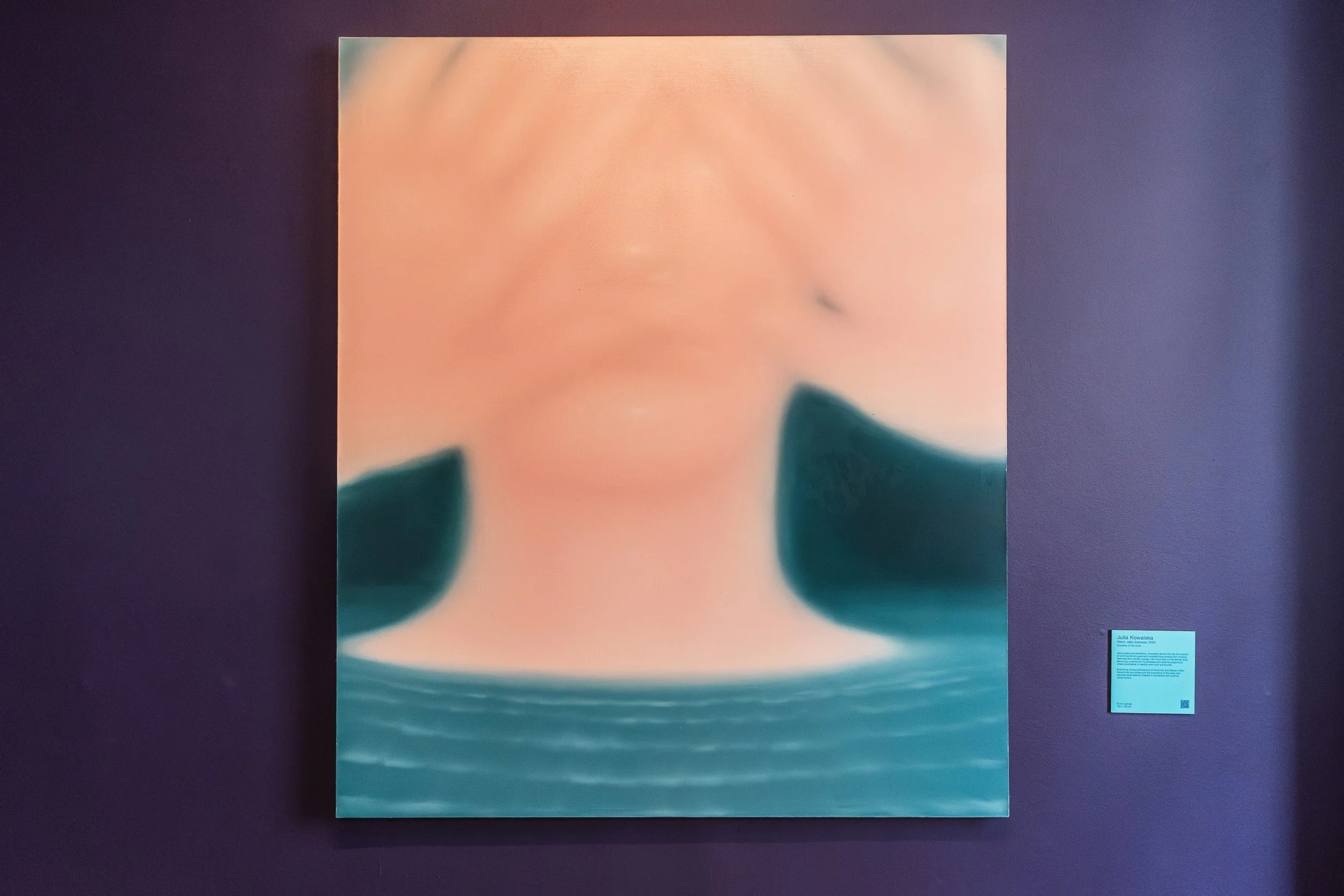
Julia Kowalska
Warm, salty forehead
2024
Oil on Canvas
140 x 120 cm
Untitled 2024 , 2024
Oil on Canvas
110x160 cm
Courtesy of Tomasz Pasiek Collection
Julia Kowalska (b. Poland, 1998), lives and works in Warsaw, Poland. She earned an MFA in Painting from the Academy of Fine Arts in Warsaw in 2022.
Using seductive aesthetics, Kowalska delves into the fluid nature of evolving female gaze and contradictions arising from multiple identities that women occupy. Her focus falls on the female body becoming a vehicle for its fantasies and external projections, where boundaries of identity and myth are blurred.
Examining various dimensions of femininity and beauty within hierarchical structures and the biopolitics of the body, she explores ambivalence inherent in the female form and its consumption.
Oliver Laric
Work descriptions:
Metamorphosis (2025)
4K video
Morphs between 3D models from diverse online archives such as maritime research institutes or art historical museums, hybridising a complex range of categories.
Untitled (2014)
4K video
Scenes of involuntary transformation from the history of animation spanning over 100 years, redrawn frame by frame as vectors.
Artist Bio:
Oliver Laric’s multimedia work engages with themes of metamorphosis, hybridity and transformation. He is a cofounder of the art blog vvork.com (2006 - 2012) and founder of the database for copyright free 3D models threedscans.com (2012–ongoing).
Ligia Lewis
deader than dead (2020)
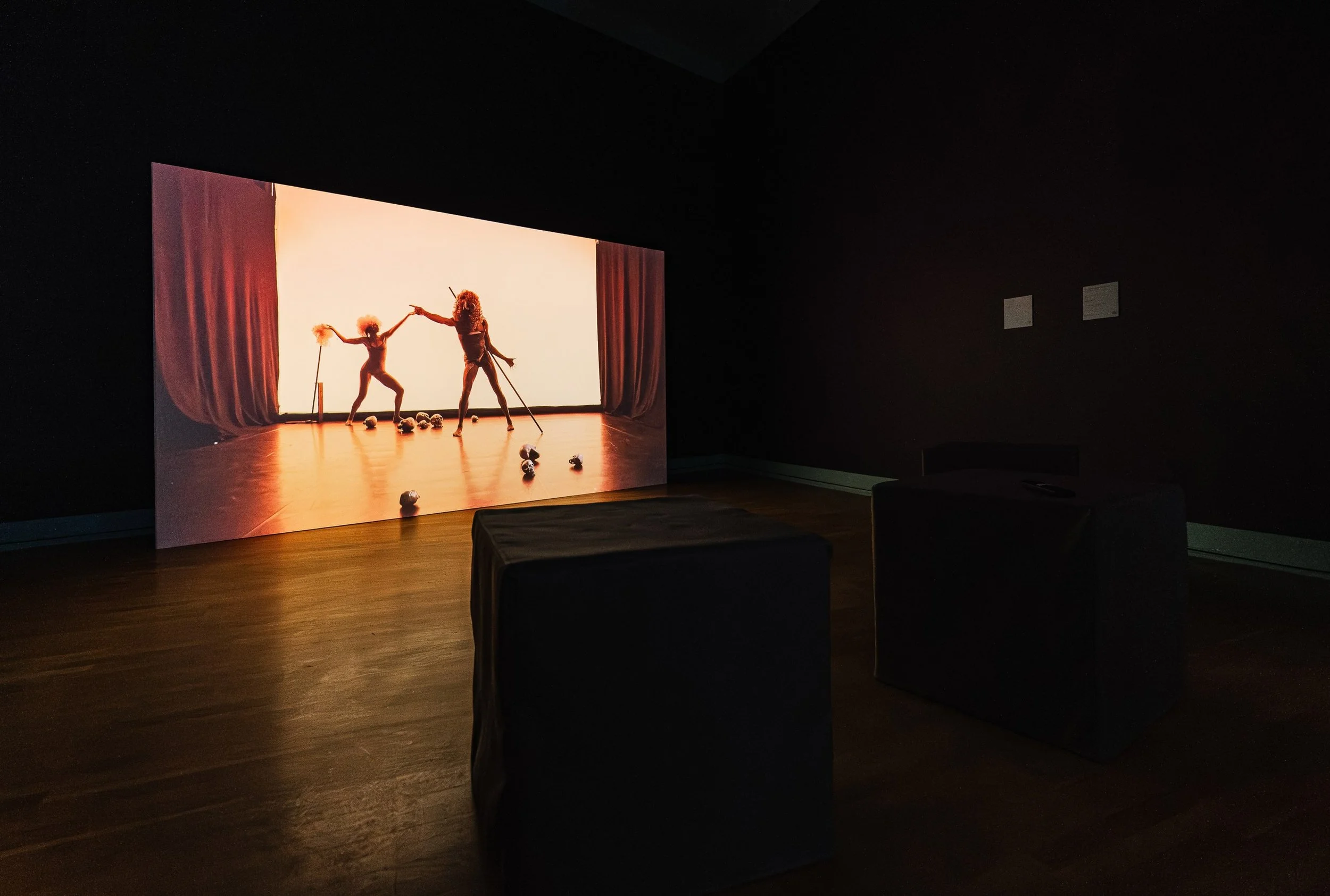
For Made in L.A. 2020, Lewis has produced and directed deader than dead, which began with an intrigue-based inquiry into deadpan, an impassive mannerism deployed in comedic fashion in order to illustrate emotional distance. Utilizing this expression as a type of stasis, Lewis initially developed a choreography for ten dancers that remained expressively flat or dead, resisting any narrative or representational hold tied to a climactic build or progression. Lewis had relegated deader than dead to this corner of the gallery (a kind of “dead” space) where the dance would ostensibly emerge, although deadened in its repetition, limited in its fate, as it ricocheted from wall to wall. She abandoned this recursive ensemble of death due to COVID-19, reducing the cast to four performers and pivoting to a more traditionally theatrical presentation. In this new work the dancers use Macbeth’s culminating soliloquy (“Tomorrow, and tomorrow, and tomorrow,” a reflection on repetition and meaninglessness) as the beginning of a work that unfolds in modular parts, each one an illustration or parody of death, stasis, and the void, each one tied to its own carefully selected soundtrack or sample. The work is full of play but is also a meditation on “playing,” or acting, as well as on tragedy’s recurring cycles and familiarity within Black experience; on time, as it loops; on performance; on touch, as an act of both care and violence. The work is built in the form of a musical lament, a protracted complaint on loop performed ad infinitum, decomposing itself along the way. Yet Lewis presents her grim subject—the farce of progress—with a healthy dose of humor and comedic tropes, riffing on the concept of “corpsing”—a theater term for unintentional laughter at a noncomedic moment, “playing straight” during a humorous scene, or simply breaking character. Corpsing, in the words of the philosopher David Marriott, is associated with “moments in which an actor exceeds the limits of theater and no longer is in command of a role.” But in those slippages in character, he states: “if black life matters, it cannot be as . . . the poetical grasp of a historical meaning, nor as the breathless emergence of a politics of ascent. For such roles are not meant for the living; they depend on the idea that blacks can only perform and perfect the role of their deaths, and that they should do so forever.
Credits:
Concept, choreography, artistic direction, scenic design: Ligia Lewis in creation with Performers: Austyn Rich, Jasper Marsalis, and Jasmine Orpilla
Sound dramaturgy, and design: Slauson Malone, with excerpts by S McKenna
Costumes: Marta Martino
Texts: Ligia Lewis, Ian Randolph, Shakespeare, and Ian McKellen on Shakespeare
Song: Guillaume de Machaut, “Complainte: Tels rit au main qui au soir pleure (Le remède de Fortune),” ca. 1340s
Wigs: Gabrielle Curebal
Film Credits Produced by Reza Monahan Studio and Jim Fetterley
Editors: Ligia Lewis and Steven Wetrich
Additional support for this project was provided by Human Resources Los Angeles, ICA Los Angeles, and The Underground Museum
A Plot, A Scandal (2023)
A plot is a word referring to a story or narrative, a piece of land or property, and the act of scheming or plotting. Intricately entangled in the film “A Plot, A Scandal”, Lewis engages themes of “scandal” and resistance on the island of Hispaniola, and the greater Caribbean. Lewis explores such pleasures and their cost weaving together a series of historical events, political laws, and mythical narratives, ranging from John Locke’s treatise on white man’s ‘natural rights’ to life, liberty, and property to Jose Aponte’s revolutionary plot that led to the slave rebellion in 1812, to Lewis’s great-grandmother, a guiding figure for the community who unfolded alternative forms of resistance such as the Palo dance. Thus, “A Plot, A Scandal” operates as a space of resistance, inviting the scandal of rebellion at the edges of storytelling.
A Plot, A Scandal (2023) was filmed within the medieval town of Santarcangelo di Romagna, Italy. One recurring aspect of the landscape is the towering cypress trees, ordered in rows, and the bell tower – its sonic resonance opening the film and later revealed as a towering monument, pointing to the Christian ideals that served as both a precursor to the Enlightenment and a bedfellow in maintaining its hierarchical order. Utopian or mundane, how might scandal reveal what lies unwittingly close to our fantasies? Is it the demand for repair? Or the otherwise brutish desire for revenge? Credits: Film by Ligia Lewis Featuring Corey Scott-Gilbert and Ligia Lewis Scored by George Lewis Jr (AKA Twin Shadow) and Wynne Bennett Concept, Screenplay, and Direction: Ligia Lewis Director of Photography: Moritz Freudenberg Editor: Dragana Jovanović Commissioned by the Center for Art, Research and Alliances (CARA)
Short bio:
Ligia Lewis works as a choreographer, dancer, artist, and director working across stage, exhibition, and film. Her works are marked by physical and emotional intensity, where comedy and tragedy collide. Through her practice, performer and audience confront processes that disrupt normative conceptions of the body, as her work moves between the familiar and the unfamiliar. Her work is held together by the logics of interdependence, disorder and play.
Lewis negotiates the ghostly traces of history, memory, and the un/known. She gives space for the emergent and the indeterminate while tending to the mundane. In her work sonic and visual metaphors meet the body, materializing the enigmatic, the poetic, and the dissonant. Her work continues to engage the nuances of embodiment. For Lewis, choreography is the movement of ideas across bodies—meticulously conceived, crafted, and directed—as a political act: a writing against the grain of the racial regime of representationalism and Black erasure.
“A theater is perhaps a kind of vise, a mechanism for durational holding. The best artists working in the form understand that whatever is placed between the proscenium’s jaws—sound, light, language, bodies, movement—is so clutched to facilitate the material’s irrevocable transformation, often via brute force. Ligia Lewis is one such artist.” — Catherine Damman, Andrew W. Mellon Postdoctoral Fellow, Wesleyan University
Jacopo Mazonelli
Works: Volume V11, 2025, clarinet, concrete, iron, 144.5 x 66.5 x 14 cm.
Spaltung, 2025, re-assembled piano fallboard, brass, 130.5 x 65 x 6 cm.
Courtesy of the artist and Galleria Studio G7, Bologna
Works:
Volume
Volume, whose title refers ambiguously both to the spatial extension of solids and to the intensity of a sonic emission (usually measured in decibels), consists of a clarinet embedded within a concrete parallelepiped, rendering it almost entirely unusable. The work overturns the idea of music as the bodily performance of a player, suggesting instead that sound may be gravity, matter, a volume to be filled with a vital pneuma.
Art has long borrowed its vocabulary from music: tone, harmony, chord, timbre are only a few of the musical terms that art criticism has appropriated in an attempt to formulate—or at least approach—the truth of the artwork. The term volume, in its double meaning of “space occupied by a body” and “intensity of a sonic emission,” belongs to this shared lexicon, appearing in both sculpture and music. This dual identity returns the fertile ambiguity expressed by the series titled Volume: concrete parallelepipeds enclose instruments from the present or the past. The musical instrument is “walled in alive,” barely visible, suffocated by the opaque uniformity of cement. The proportions of the object and its placement—on iron supports at human height—encourage a direct relation between the observer and this “work of coercion.” The usual idea of listening “at full volume” is annulled to foreground an image of sound as weight, gravity, an autonomous entity.
Mazzonelli performs a process of physical and conceptual contraction and subtraction in order to create an image that reveals the pure status of sound beyond the process that generates it. With an act of courage, he formulates a wager and pursues it to its extreme consequences: he investigates the acoustic process while renouncing the category of listening. The immateriality of music acquires visual evidence through a silent thematization of sound waves.
Spaltung
Spaltung takes the lid of a Bechstein piano, divides it into two elements, and arranges them vertically, revealing an only apparent continuity, where the inner fracture becomes part of the structure itself. In this form, the double is not a reassuring duplication; it is the gap that allows function to reveal its anthropological and political dimension. As Deleuze suggested, authentic repetition never replicates but differs: here difference is not an aesthetic variation, but the place where matter becomes conscious of its own history and of its possible transformation.
Sound, when present, never comes to completion; when absent, it is felt as latent pressure. In any case, it remains a signal that something continues to operate despite the visible disarticulation. Each work sustains a contemporary collective condition: living within a system no longer stable, yet persistent, where parts support one another, correct one another, re-embrace in new and unresolved forms. There is no definitive repair, only a continuous attempt to function.
This is where these works breathe: in the interstices of the psyche, where what should be linear reveals itself instead as composite, fragile, and necessary.
Bio:
Jacopo Mazzonelli (*1983) creates sculptures, installations and performances that investigate the wide border area between visual arts and music. His research is characterized by techniques and methodologies borrowed from different disciplines. By working on the interpretation and visualization of the sound dimension, the artist faces tools that he deconstructs, transforms, and reassembles. The focal points of his interest are the “musical gesture”, the investigations on the perception of rhythm and the becoming of time. He has held solo exhibitions in Italy and abroad.
Lucy McRae
Work:
Los Angeles-based artist Lucy McRae has created a survival kit for a post-apocalyptic future, designed to be carried on the body like a mountain porter. Future Survival Kit is a series of machines that shine light on society’s forever connectedness and the symptoms of technology, where human interactions more and more take place in the digital world, overshadowing our physical selves. This symptom has led us to a ‘Touch Crisis’, demanding interventions that cater to society’s physical and emotional needs.
Bio:
Lucy McRae leads an art-led speculative lab for the future of humanity – A constellation practice and network of scientists, artists, and designers prototyping body futurism and post-nature futures, through worldbuilding and introspection. Her artisanal approach to technology brings science to street level— creating imaginary worlds, in sculpture, film and conceptual fashion, exploring who we are, and where we are headed.
In parallel to her gallery and museum-focused art practice Lucy thrives as a strategic and versatile thought partner to brands, Institutes, and Hollywood Writers' rooms, including Blade Runner 2099. Renowned for her agility and exceptional capacity to connect far-reaching dots, Lucy brings a multiplayer mindset to thought experiments and design led innovation, drawing from her experience leading the far-future research division at Dutch multinational Philips (2006-10) developing wearable technologies with emotional sensing capabilities.
A Visiting Professor at SCI-Arc, co-directing a futures incubator, Lucy is a World Economic Forum, Young Global Leader and TED Fellow.
Marcus Nelson
Facial Leakage, 2026, oil on canvas, 143 x 183cm, (90 x 70cm each canvas),
courtesy of the artist
Facial Leakage
Facial Leakage is a phenomenon coined by psychologist Paul Ekman, which refers to the involuntary, fleeting micro-expressions of the face that reveal emotions an individual is trying to conceal. A subtle smirk, a raised eyebrow, a brief look of disgust: these moments momentarily expose ones true feelings, and become representative of an internal dialogue often masked in social situations. In this quadriptych, these moments are explored rhythmically across four panels, where the shifting nature of the face becomes a representation of tensions and contradictions embedded in the human psyche. Using a tight compositional crop that frames the subject from the eyebrows to the mouth – known in cinema as a ‘choker shot’ – the face becomes isolated as a core means of human expression.
BIo
Marcus Nelson (B. 1997, Oxford, UK) is a British artist based between Berlin and London. Taking inspiration from theoretical texts, sociological studies and theatre plays, he uses his own body to shape the final outcomes of the work, exploring how our sense of self becomes fragmented as we present different masks to the external world. Through painting, installation and film, Nelson’s work seeks to explore the isolation, paranoia and hidden trauma embedded in modern existence, questioning the authenticity of the self and how we perform within a confined urban environment.
Mike Pelletier
Constraint Iterations 2, 2019
2019, 5:23 min
Animation: Mike Pelletier
Music: Jacek Doroszenko
Bio
Mike Pelletier is a Canadian artist based in Amsterdam, Netherlands. His work explores the divide between digital and physical space, usually getting lost in the uncanny valley that lies between. His work often focuses on how technology is used to represent the human body while being informed and influenced by art-historical practices of image making and representation. Pelletier’s work has been shown in exhibitions and festivals around the world. He holds a Master’s Degree from the Piet Zwart Institute in Rotterdam. He was awarded a Prix Ars Electronica Honorary Mention in 2016 and the FILE Video Art Award in 2017.
Haleh Redjaian. Untitled, 2020 & Aperture I, 2021
Untitled, 2020
threads and lithography on handwoven textiles
100 x 100 cm
Courtesy of the artist
Aperture I, 2021
mixed media on embossed paper
28 x 33,5 cm
Courtesy of the artist
Bio
Haleh Redjaian (born 1971, Frankfurt/M) lives and works in Berlin. She studied Art History at the Goethe University of Frankfurt and furthered her studies in drawing and printmaking followed by sculpture at the Royal Academy of Fine Art in Antwerp and completed a postgraduate degree in Fine Art from the Higher Institute of Fine Art (HISK)in Belgium. Redjaian has participated in several group and solo exhibitions including: Heimweh nach neuen Dingen, Kunstmuseum Bonn, Konkrete Frauen, Kunstmuseum Ahlen (2025), In Real Time, NYU AbuDhabi Art Gallery (2024), Haleh Redjaian im Dialog mit Sofie Dawo, Kunsthaus Dahlem (2024), Sehen im Kunstverein Aschaffenburg (2023), My dream never has walls, Duo-Exhibition Fernanda Fragateiro & Haleh Redjaian, Valerie Traan Gallery Antwerpen (2023), Raising Flags, Museum in progress Vienna (2023), The Tide is High, Kunsthaus Wiesbaden (2022), Klangteppich IV Festival, Telegrafie & Klangkunst, TAK, Berlin (2022), L‘année dernièr à Malmaison, SAC Bucharest, (2022), Textile, Haunt Berlin & drj art projects, Berlin (2022), Stasi frenetica, MAO, Turin 2020, White Leaves One and Two on Their Place, Gallery Isabelle van den Eynde, Dubai (2020), Some Things Last A Long Time, Kajetan Berlin (2019), among others.
Untitled, 2020
Haleh Redjaian’s artistic work is based on the intersection of cultural research, traditional craft techniques, and contemporary visual language. The starting point is often textile practices and their embedding in social and cultural contexts. Redjaian is particularly interested in how intangible knowledge—such as songs, narratives, or rituals—influences the creation and transmission of visual patterns. Textile patterns are often carriers of knowledge, the focus is on how this knowledge—passed down through generations via songs, stories, or rituals—becomes inscribed in craft techniques. A central point of reference is Naqshe Khani, a practice of Iranian carpet weavers in which visual patterns are transmitted through sung instructions.
Aperture I, 2021
“Aperture I” belongs to a series of drawings. The title refers to any opening or gap, and is used metaphorically to describe an entry point or way of seeing something.
Caroline Poggi, Jonathan Vinel.
Description:
LA FILLE QUI EXPLOSE
2024
Duration 19'
Aspect ratio 1:1.77
Container size 2K (res : 2560x1440)
Frame rate 25fps
Sound 5.1
CRÉDITS
Réalisateurs Caroline Poggi & Jonathan Vinel
Scénaristes Caroline Poggi & Jonathan Vinel
Productrice Oriane Hurard (Atlas V)
Avec la voix de Grace Seri
Conception 3D & animation Saradibiza, Lucien Krampf
Musique Malibu
Montage son Olivier Voisin
Mixage Victor Praud
Etalonnage Emmanuel Fraisse
Description:
For the past three months, Candice has been exploding every day. Sometimes even 2 or 3 times a day. Her record is seven times. She currently has 192 explosions.
Comment ça va?
Year: 2025
: 31 min
Fiction, Animation
Directed by: Caroline Poggi, Jonathan Vinel
Written by: Caroline Poggi, Jonathan Vinel
Cinematography: Pauline Doméjean
Editing: Jonathan Vinel
Sound: Lucas Doméjean, Olivier Voisin, Victor Praud
Animation and 3D: Stanislas Bécot, Hugo Glavier, Lazare Aïbout-Sibille Casting: Kris de Bellair
Producer: Caroline Poggi
Production company: 444 Films
Cast:
Elephant (Elephant): Ariane Ascaride
Penguin (Pingouin): Oulaya Amamra
Lion: Galatéa Bellugi
Cow (Vache): Grace Seri
Rabbit (Lapin): Mouna Soualem
Monkey (Singe): Barbara Braccini
Wolf (Loup): Claude-Emmanuelle Gajan-Maull
Pig (Cochon): Océane Court-Mallaroni
Synopsis:
A group of animals live on a wild coastline and try to heal the ills caused by the contemporary world. A kind of rehab.
bio:
Caroline Poggi, born in Ajaccio in 1990, and Jonathan Vinel, born in Toulouse in 1988, are a duo of French artists. Their works are showcased in both contemporary art and cinema. Known for blending themes of resistance and revolution with hybrid multimedia forms, their films give voice to the anger, stress, and disillusionment of the contemporary generation.
Aki Sasamoto - Point Reflection
Details:
Aki Sasamoto
Point Reflection
2023
Digital video, 23 minutes 31 seconds
Videography: Ben Hagari
Courtesy of the artist
Work:
In Point Reflection (2022), Sasamoto creates an environment of structured improvisation to explore ideas of change, probability, and chance. The work is filmed from beneath a custom “float table”, which pushes air upwards so that objects hover and skip across the surface. Snail shells, foam cubes, CDs, coffee cup lids, straws and other contemporary detritus collide and rebound, set against a soundtrack of experimental jazz by Matt Bauder. Sasamoto gradually begins to intervene, adding and removing objects, blowing air through a straw, and drawing directly on the surface, creating a choreographed chaos that invites reconsideration of the mundane through improvisation and play.
Bio:
Aki Sasamoto (b. 1980 in Kanagawa, Japan) is a New York-based artist working in performance, dance, installation, and video. Sasamoto uses everyday objects, movement, and linguistic wordplay to mine the absurdity of the human experience. Her work subverts the familiar through improvisation and repetition, inviting unlikely interactions between objects and people.
Edra Soto
por la señal #17, 2024
Sintra, MDF, latex paint, viewfinder, inkjet print
24h x 20 1/4w x 3d in
60.96h x 51.44w x 7.62d cm
(ES_130)
$ 6,500.00
Copyright: Copyright The Artist
Courtesy of Morgan Lehman Gallery
Por La Señal #16, 2024
Sintra, MDF, latex paint, viewfinder, inkjet print
24h x 20 1/4w x 3d in
60.96h x 51.44w x 7.62d cm
(ES_129)
$ 6,500.00
Copyright: Copyright The Artist
Courtesy of Morgan Lehman Gallery
In por la señal, an ongoing series of abstract works, Soto draws from Puerto Rican rejas, wrought iron screens common in the archipelago’s lower and middle-class communities. Rooted in her personal history and cultural heritage, the work examines connections between Puerto Rican cultural memory, African and Black influences, and the colonial history of the United States.
Within por la señal, Soto reinterprets the tabernacle, a devotional object also known as “the place of dwelling,” derived from her Catholic school upbringing. The artist has documented her frequent travels to Puerto Rico through photographs, these images make their way into the work by way of viewfinders implanted within each piece. By revisiting the tabernacle's symbolism alongside personal documentation, Soto questions indoctrination methods rooted in colonial traditions and transforms the tabernacle into a space for personal memory.
The title por la señal, taken from a phrase used in Catholic rituals, also points to themes of communication and migration. Through this body of work, Soto explores migration and her relationship to her maternal heritage, offering an intimate view of the cultural and historical forces that shape her identity. The series traces the threads of colonial lineage in the United States while continuing to confront and reframe Puerto Rican cultural memory.
bio:
Edra Soto (b. 1971, San Juan, Puerto Rico) is an interdisciplinary artist, curator, and educator based in Chicago, where she also co-directs the outdoor project space The Franklin. Drawing from her upbringing in Puerto Rico and her life in the United States, Soto’s work examines constructed social orders, diasporic identity, and the enduring effects of colonialism.
Her work has been exhibited widely at institutions including the Museum of Contemporary Art Chicago; Whitney Museum of American Art, New York; ICA San Diego; Kemper Museum of Contemporary Art, Kansas City; Phoenix Art Museum; Carnegie Museum of Art, Pittsburgh; and SculptureCenter, Cleveland, among others. Recent projects include her participation in the Chicago Architecture Biennial, a major commission for the expansion of O’Hare International Airport’s Terminal 5, and GRAFT, a large-scale installation commissioned by Public Art Fund for Doris C. Freedman Plaza in Central Park, New York, and a Special Project at Untitled Art Miami 2025 with the Morgan Lehman Gallery.
Soto is the recipient of numerous awards and fellowships, including a USA Fellowship, the Joan Mitchell Foundation Painters & Sculptors Grant, the Joyce Foundation Award, an Illinois Arts Council Fellowship, the 3Arts Next Level Fellowship, the Foundwork Prize, the Ree Kaneko Award, and a fellowship from the US Latinx Art Forum. She has participated in international exchanges in Brazil, Puerto Rico, and Cuba through the MacArthur Foundation’s International Connections Fund, and has attended residencies at Skowhegan School of Painting & Sculpture, the Robert Rauschenberg Foundation, Headlands Center for the Arts, Project Row Houses, and Art Omi.
Her work is held in the collections of the Whitney Museum of American Art; Smithsonian Asian Pacific American Center; Museum of Contemporary Art Chicago; Art Institute of Chicago; Pérez Art Museum Miami; Museo de Arte de Puerto Rico; McNay Art Museum; DePaul Art Museum; and other public and private collections.
Soto holds an MFA from the School of the Art Institute of Chicago and a BFA from the Escuela de Artes Plásticas y Diseño de Puerto Rico.
Monika Szpunar. 100m
Film title: 100m
Release date: 2022
Film description in English:
A short dance film based on a precise choreography of the camera and the dancer reflecting an individual journey through different stages of grief. Filmed in a single take in a long industrial tunnel, within its strict temporal and spatial framework, and accompanied by a soundtrack entirely created from sounds recorded in the tunnel, 100m underlines the uniqueness of this intimate experience.
Short bio:
Monika Szpunar is a multidisciplinary artist, dancer and choreographer working internationally mostly between Poland, France and Czech Republic. Interested in bringing dance to new, unconventional spaces, and the meeting of choreography with other disciplines, she often works with collective and interdisciplinary projects. She is a graduate of ACTS/Ecole de Danse Contemporaine in Paris and The Place, London Contemporary Dance School in London. In 2016, she spent six months in Brazil, where she collaborated with local artists and continued to study at Unicamp in Campinas.
She co-creates the choreographic initiative practices of sisterhood (Aerowaves Artist 2024) and a movement band BADBODYCHAOSCODE, works at the Krakow Choreographic Centre and develops her own projects, performances and films.
Credits:
Director & Performer: Monika Szpunar
Choreography: Monika Szpunar & Dominika Wiak
Director of Photography: Franek Przybylski
AC: Kajtek Zieliński
Gaffer: Patryk Waś I CINELIGHT
Soundtrack: Joanna Wabik
Sound mastering: Wojtek Szustak
Still photography: Eliška Wilczek
Location: Nowe Centrum Administracyjne
WITH SPECIAL THANKS TO:
Nowe Centrum Administracyjne
Krakowskie Centrum Choreograficzne
Paweł Soja
Kacper Gawron
Monika Tryboń
Beata Zuba
Artist supported by Fundusz Popierania Twórczości Stowarzyszenia Autorów ZAiKS Poland, 2022
Technical specifications of the film:
16:9
Duration:
5 minutes 43 seconds
Asia Stewart, cat got your tongue, 2025
Details:
cat got your tongue, 2025
two steel desk treadmills, two digital tablets, two aluminum tablet mount clamps, 300 sticks of watermelon-flavored 5 Gum®
Installation dimensions vary
cat got your tongue, 2025
Digital videos: 07:44 minutes and 30:50 minutes
Known Dimensions:
treadmills: 36 x 22 x 44 inches each
tablets: 6.54 x 10 x .28 inches each
Work:
Stewart developed the durational performance cat got your tongue after getting diagnosed with an auto-immune disease that affected her mobility. The core action in the performance is straightforward; she chews gum while walking on a desk treadmill. Once flavorless, she sticks the chewed gum underneath her sneaker and places a new piece of gum into her mouth. After chewing and sticking hundreds of pieces of gum to the treadmill, the sticky material overrides the power of the electronic machine and renders it an immovable sculpture.
In this performance, she tests the limits of her own body and the machine, pushing against the expectation that productivity should be optimized and continuous. cat got your tongue ultimately presents Stewart's refusal of efficiency.
Originally performed as part of "a grammar of attention" | The Whitney Museum's Independent Study Program Curatorial Exhibition
Bio:
Asia Stewart is a performance artist whose conceptual work centers her body as a living archive. Many of her performances unfold as social experiments that negotiate terms of agency and power with audiences. Stewart’s performances have been supported by organizations that include The Bronx Museum, The Shed, Franklin Furnace, A.I.R. Gallery, Silver Art Projects, Marc Straus Gallery, Marble House Project, GALLIM, The Watermill Center, and the Brooklyn Arts Council.
Stewart routinely questions how live art can be documented and represented across multiple mediums. Her photographs and videos have been exhibited at venues across the United States, including the Mercury Store, Untitled Space, NARS Foundation, Goodyear Arts, A.I.R. Gallery, Kellen Gallery, and Anthology Film Archives. Her first series of prints is also held in the permanent collection of the Mint Museum in Charlotte, NC.
Judith Wagner
Works:
Ikarus, 2023, Sewa-Cryl painted, 50x110x192 cm.
Langarmfiguren, 2021, Sewa-Cryl painted, Figur 1: 90x60x75 cm, Figur
2:110x47x63 cm, Figur 3: 45x50x160 cm.
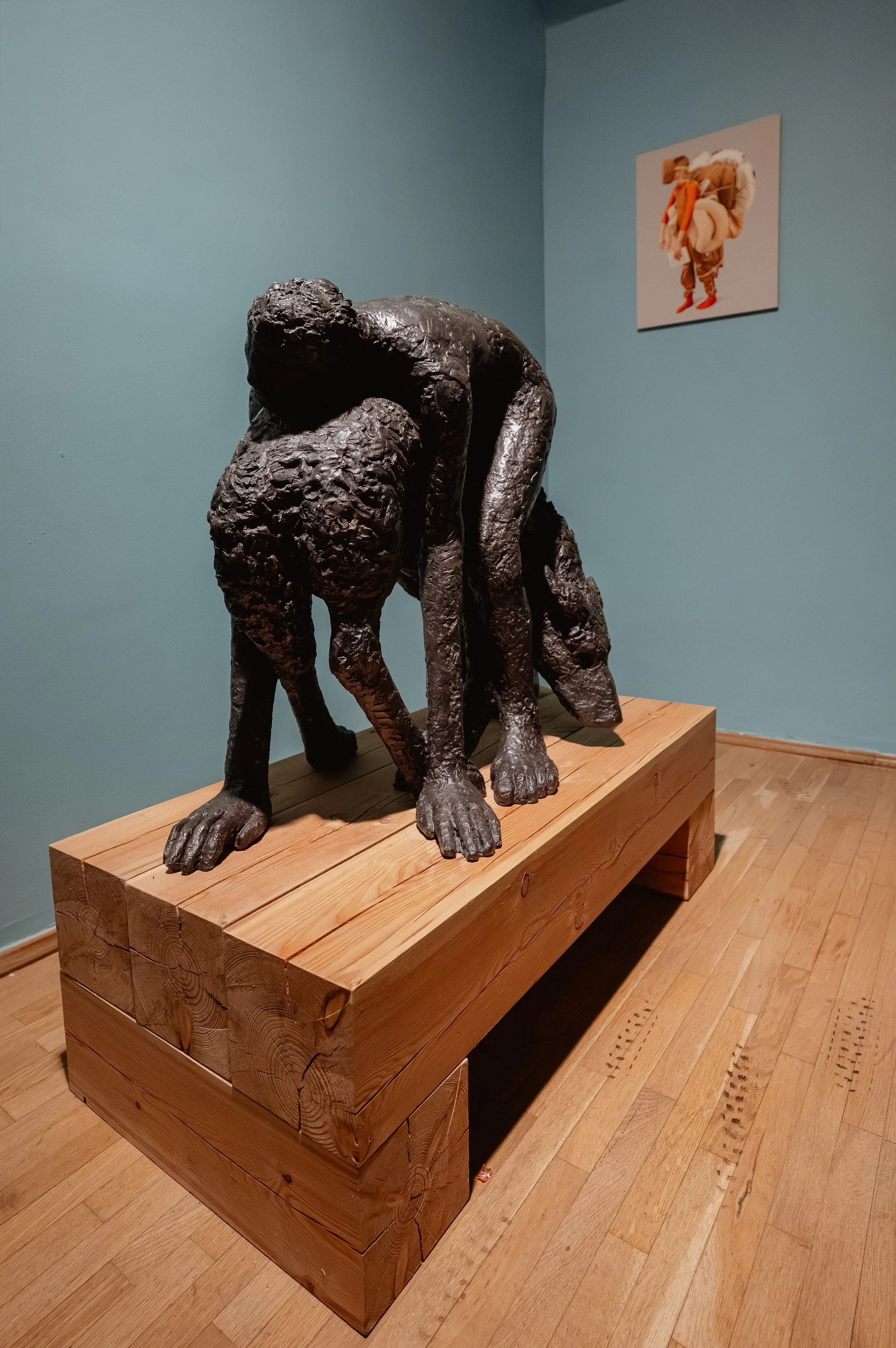
Wolfsknoten, 2022, Bronze, 1/6, 89x40x67 cm.
Unter Wölfen, 2020, Bronze, lebensgroß
Ikarus:
The Ikarus sculptures evoke a fragile balance between ascent and fall, where the figure appears caught in a suspended moment between striving and collapse. The reference to the myth of Icarus is translated into a restrained, introspective form: the quiet tension of ambition and its limits.
Langarmfiguren:
The sculptures evoke a striking sense of elongation as emotional tension, where the extended limbs seem to carry an inner psychological weight rather than merely a physical gesture. The exaggerated reach suggests a movement beyond bodily limits, an attempt to grasp or transcend while remaining grounded in stillness. This stretching introduces a quiet vulnerability, as the body appears exposed and subtly destabilized, suspended between strength and fragility.
Wolfsknoten:
Wolksknoten evokes a tense entanglement between human and animal, where forms appear knotted together in a state of unresolved transformation. The suggestion of a wolf–man hybrid introduces a primal, instinctual dimension, as if the body is caught between control and wildness. This knotting becomes both physical and psychological, expressing an inner conflict where identity is neither fixed nor fully separable, but bound in a continuous, incomplete fusion.
Unter Wölfen:
In Unter Wölfen, Judith Wagner explores the archaic and uncanny qualities of animals, wolves, horses, goats, that carry emotions stored within us across generations. The wolves embody our fears and shadow sides, as well as the aspects we secretly long to embrace. Within this pack, the human figure learns to move like a wolf, physically inhabiting these primal traits.
Bio:
Judith Wagner (b. 1973, Vienna, Austria) is a sculptor working between figuration and abstraction. She studied at the University of Applied Arts Vienna and the Oslo National Academy of the Arts. Wagner lives and works in Lower Austria and teaches at the New Design University in St. Pölten.
Her practice centers on the human figure as a site of psychological and existential inquiry. Through subtle deformation and reduction, her sculptures translate inner states into physical form, creating works that oscillate between presence and absence. Often life-sized, her figures engage viewers directly, inviting reflection on perception, identity, and embodiment.
Wagner has exhibited internationally and her work is held in public and private collections.
Leyla Yenirce, Atlas
Atlas, 2025
Signed and dated verso
Oil, acrylic spray and silkscreen ink on canvas
180 x 200 cm
70.9 x 78.7 inches
Leyla Yenirce. Courtesy the artist and Capitain Petzel, Berlin.
Description:
Using oil paint, acrylic spray paint and silkscreen ink on canvas, Atlas includes printed motifs depicting female Kurdish freedom fighters using binoculars to survey the land and sky. Additionally, Yenirce layers blueprints of F-16 fighter jets, used extensively by Turkey in conflict with these women fighters, and Google Earth views of the controversial Ilisu Dam project, built and finalized by Turkey in 2018. Mapping tools of ruin, the images relate to each other in various ways: while the jets are used to control the area where the women operate from above, the dam has flooded about 200 villages from below, as rising water levels overflow the banks of the Tigris River and submerge regions where people have lived for millennia. As the artist states, only between the earth and the sky, “on eye level, can these women exist.” Yenirce creates complex compositions which fuse signposts of war with geographies of displacement, a vantage point both from afar and from within.
Bio:
Leyla Yenirce was born in Qubînê in 1992 and grew up in Oldenburg as the child of Yazidi refugees. She studied cultural anthropology and fine arts in Hamburg and Bryn Mawr (USA). Since then, she has been working across media on the figuration of feminist resistance. Today, the visual artist lives and works in Berlin.
Jorinde Voigt
Blaues Paradox (2), (4), (6), 2020
ink, gold leaf, pastel, oil, chalks and graphite on paper, framed
47 x 37 x 3.1 Cm each
Immersion -
Superpositions VI, 2025
ink, oil chalks, gold leaf and pastel on paper,
artist's frame 81.2 x 140.7 cm / 91 x 150 x 9 cm
Bio:
Jorinde Voigt (* 1977 in Frankfurt am Main) is a multidisciplinary visual artist based in Berlin. From 2014 to 2019 she was a professor at the Academy of Fine Arts in Munich, and since 2019 she has been Professor of Conceptual Drawing and Painting at the Hochschule für bildende Künste Hamburg.
In her artistic practice, Voigt explores processes of inner perception in relation to various aspects and themes such as affects and emotions, imagination, memory, sensory experience, natural and cultural phenomena, scientific data and philosophical concepts, as well as interpersonal actions and relationships. Since her early works, Voigt has pursued an analytical approach, understanding her subjects as dynamic constellations whose internal structures are in a constant state of flux. As part of her conceptual approach, she has in recent years expanded her practice beyond the medium of drawing to include painting, collage, sculpture, design, music, and architecture.
Nives Widauer
PRANAYAMA, 2022
LV-Bag, motors & sound
32 x 25 x 36 cm
A luxury bag begins to breathe—its movements rhythmic yet uneasy. Is it alive? Who inhabits it? Does it carry the story of a successful figure, or of a stressed body seeking relief in a yoga class?
The work questions whether objects of desire can slip into something uncanny, uncomfortable, strange, even nightmarish, or instead become animistic, humorous presences that introduce a dreamlike charge into everyday life, without the need for artificial stimulation.
Pranayama is part of an ongoing series of bag interventions that Nives Widauer has been developing since 2010, rooted in her personal fascination with bags and her sustained interest in transformation.
Bio:
Nives Widauer (b.1965, Basel) is a Vienna-based artist whose interdisciplinary practice spans video, installation, sculpture, painting, drawing, and collage. Trained in audiovisual design at the Basel School of Design, she has developed a unique artistic language characterized by the fluid integration of diverse media and techniques. Her work draws together autobiographical traces, cultural and art historical references, collective memory, and language, forming a personal yet universally resonant visual mythology. In addition to her extensive international exhibition history, which includes institutions such as the Kunstmuseum Basel, Kunsthaus Zürich, the New-York Historical Society, the Austrian Cultural Forum, and the Belvedere Museum Vienna, she also designs live-video stage environments for opera, theater, and music. Her published works include Villa Nix (2019), SPECIAL CASES (2017), and DO I DREAM OR AM I ALIVE? (2011), among others.
Christian Jankowski
Hooping Guggenheim, 2022
5 b/w photographs on baryta paper
125 x 93,5 cm each
Ed. 4/5 + 2AP
Courtesy the artist and Suprainfinit Gallery
In the photo series Hooping Guggenheim, Jankowski challenges the relationship between the artist and the institution. After decades of working with, within, and at times even constrained by various institutions, he selects the iconic Guggenheim Museum as both a sports partner and a playmate.
A model of the building’s quintessential rotunda was constructed in separate parts, which the artist brought to a photography studio for a one-hour session, with the simple goal of keeping the museum in the air for as long as possible. This action was documented photographically, resulting in a series of five inkjet prints.
From there, Jankowski and the Guggenheim model moved to the institution itself, joined by local hoopers gathered through social media and the hooping community. Their aim was to hoop around the museum’s façade: as one participant left off, another continued, creating a visual metaphor of collectively “upholding” and “moving” the institution.
Bio:
Christian Jankowski is a leading figure in contemporary conceptual art. Much of his work is collaborative, opening up an exchange between the world of art and other fields. Taking inspiration from mass media formats and popular culture, he draws attention to the lenses through which experience is translated, resulting in works primarily in performance, video, and photography, but also installation, sculpture, and painting. People inscribe themselves in unpredictable situations of the artist’s making, revealing something of the relationships and beliefs that shape society. The emphasis is on the process and its potential for transformation.
Born in 1968 in Göttingen, Germany, he lives in Berlin and works internationally. He studied at the University of Fine Arts, Hamburg, Germany and since 2005, has held a professorship at the State Academy of Fine Arts Stuttgart.
Solo exhibitions include Contemporary Fine Arts, Berlin (2025) and Basel (2024), Overbeckgesellschaft, Lübeck (2023); Kunsthalle Tübingen (2022); Fluentum, Berlin (2020); Suprainfinit Gallery, Bucharest (2020); KCUA, Kyoto (2018); Petzel Gallery, NY (2018); Contemporary Fine Arts, Berlin (2016); Kunsthaus Hamburg, Germany (2015); Center for Contemporary Art, Ujazdowski Castle, Warsaw (2013); Sala de Arte Publico Siqueiros, Mexico City (2012); MACRO, Rome (2012); Frieze Projects, Frieze Art Fair, London (2011); Nassauischer Kunstverein Wiesbaden (2009); BAWAG Foundation, Vienna (2009); Kunstmuseum Stuttgart (2008); MIT List Visual Art Center, Cambridge, MA (2005); Swiss Institute, New York, NY (2001); and the Wadsworth Atheneum, Hartford, CT (2000).
Kristin Wenzel
CUPS, 2010 – ongoing
6 b/w photographs on Hahnemühle Photo Matt
30 x 40 cm
Courtesy the artist and Suprainfinit Gallery
Kristin Wenzel’s photo series CUPS focuses on an easily overlooked, everyday
detail: the bottoms of cups. In an ongoing process, she documents the subtle traces
created by stirring—lines, circles, and accumulations left behind by the movement
of a spoon. What initially appears as random patterns reveals itself, upon closer
look, as a kind of visual record of human action.
The work thus points to traces people create unintentionally. Without any conscious
artistic intent, drawings emerge that nonetheless possess a distinctive
expressiveness. It is precisely within this indifference that the core of the project
resides: these traces function as quiet indicators of inner states. Depending on the
intensity, rhythm, and form of the lines, one may infer different moods—such as
stress and restlessness or, conversely, calm and balance.
CUPS thus uncovers a subtle connection between movement, mental state, and
visual form. The repeated gesture of stirring becomes a kind of unconscious
expression that materializes and becomes legible. Wenzel’s work operates at the
intersection of documentation and interpretation, opening up a poetic approach to
the hidden traces of everyday life.
Bio:
Kristin Wenzel is an artist and currently lives and works between Bucharest and Gotha.
She studied sculpture at the Düsseldorf Art Academy, where she completed her master’s degree in 2013. Her multidisciplinary practice involves large-scale installations, sculptures
and interventions in public space, often created as site-specific and site-sensitive social
environments. The notion of transformation, be it conceptual or material, permeates her
entire practice and connects the past and present through processes of collecting and
Reinterpreting.
Recent solo exhibitions include: The Near and the Elsewhere, Dinamo Swimming Pool
Bucharest (2023), MIRA, Tranzit Bucharest (2022), LOVERS IN THE NIGHT, Goethe-
Institut, Bucharest (2021), The Coin, Ducal Museum, Gotha in collaboration with ACC
Galerie Weimar (2021), wild orchids (2020), SOX Berlin and The Near and the Elsewhere
(2020), Suprainfinit Gallery, Bucharest, Romania. In 2018, together with the artists Vlad
Brateanu, Alice Gancevici & Remus Puscariu, she co-founded Template, an artists’
initiative and exhibition project in Bucharest. As part of her artistic practice she curates
and initiates exhibitions, locally and internationally. Her recent exhibition projects include
Protect Your Heart at Work, Rezidenta BRD Scena9 (2022) in collaboration with the
Goethe-Institut Bucharest, and MEANS OF ESCAPE, curated for Kunsthaus Erfurt (2021).
Rachel Monosov
IS THERE NO ONE TO UNITE US?, 2013
Plaster, faux snake skin (unique),
35 x 71 x 35 cm
Courtesy the artist and Catinca Tăbăcaru Gallery
In 2013, before the transgender movement carved its place into our collective consciousness, Monosov made Unite Us?, a sculpture donning the hermaphroditic body of a snakeskin creature.
THE VISITOR, 2014
HDV
15:00 min
Edition of 4
Courtesy the artist and Catinca Tăbăcaru Gallery
Exploring the timeless landscape of the Judean Desert like a lost space traveler, a woman examines plants and animals. Synthetic sounds defy all logic. Through the representation of the self out of place in her own body and environment, the visitor collects information. A rootless individual hunting for her own social history.
Bio:
Rachel Monosov (b. 1987) works in performance, photography, video, and sculpture. By delving into cultural notions of alienation, territorial belonging, and identity, she reflects a rootless present rife with broader social implications. She constructs entire worlds around her subjects, which function pursuant to their own set of laws. Her personal biography is weaved throughout, loading the work with social and political concepts echoing historical events.
Monosov holds two MFAs from The Royal Academy of Fine Arts (KASK) in Ghent, Belgium, and her BA is from Bezalel Academy in Jerusalem, Israel.
Since 2017, Monosov’s work has been included in exhibitions at BOZAR and Museum Dhondt-Dhaenens in Belgium, Kunsthaus Hamburg and Bundeskunsthalle Bonn in Germany, Art Institute of Chicago, National Museum of Art in Bucharest, National Gallery of Zimbabwe in Harare, Serlachius Museums in Finland, Palazzo delle Espozitioni in Rome; and in three international Biennales: 11th Bamako Biennale, 13th Biennale of Dakar, and the Zimbabwe Pavilion at the 57th Venice Biennale. In 2019, she mounted her first solo museum exhibition at Tarble Arts Center in Illinois. She was awarded the German Academy in Rome Praxisstipendium, two grants from the Goethe Institut, the Northern Trust Purchase Prize, and was shortlisted for the Mack First Book Award. Her work has been acquired into the permanent collections of The Art Institute of Chicago, Block Museum at Northwestern University, and the National Gallery of Zimbabwe.
Monosov is a co-founder of the CTG Collective.
RO
Marta Mattioli
Solastalgia, 2026
Bronze, nickel chrome,
30 x 25 x 25 cm
3D render
This sculpture begins with something simple and human: the heartbeat. Before language, before memory, there is rhythm. The steady pulse that anchors us to the body and to the present. Solastalgia takes that primordial rhythm and places it under pressure. The anatomical heart, cast in bronze and finished in a mirror nickel polish, appears to be melting, its structure softening and slipping, unable to hold its own weight. From it, spines emerge. Not ornamental, but reactive. Defensive. The heart seems to brace itself against an unnamed force, as if survival now requires both vulnerability and armor. The mirrored surface holds the viewer inside it. Your reflection becomes part of its anatomy. It does not sit apart from us. It implicates.
The title borrows from the language of ecological grief, the quiet, disorienting sorrow felt when the place you call home changes beyond recognition. Here, that feeling is internalized. The landscape is no longer outside; it is embodied. The melting form suggests heat, exhaustion, erosion. The spines suggest adaptation, tension, refusal. Together they hold a contradiction, softness and resistance coexisting in the same organ. The heart continues to beat, even as it transforms. Its primordial rhythm persists, but altered, less a lullaby, more a signal. In this way, Solastalgia becomes less about collapse and more about awareness, a reflective monument to the fragile endurance of being human in a shifting world.
Bio:
Visual artist and graphic designer. With dual roots in Italian and Romanian cultures, her work reflects a dynamic blend of digital and physical mediums. A member of Kinema Ikon and Atelier 35, Marta actively participates in both local and international exhibitions and projects. She explores a reality suspended between utopia and the potential dystopian future, delving into the concept of organic-digital hybridization.
Marta’s creations simplify the complex interplay between traditional and digital elements, prompting viewers to contemplate the profound implications of this fusion. Her art invites us to consider the evolving nature of our world and the possibilities that lie ahead.
Roberta Curcă
Table/Tabel, 2024
coloured pencils, graphite and ink on paper
58x79 cm
Table/Tabel is a type of drawing inspired by layouts developed and utilized throughout the history of information graphics. Concentric circles often used on maps and charts are set alongside drawings of algae, sea grass or jellyfish. The subtitle variations within the table are not those of some analyzed phenomenon, but the natural differences which occur while freehand drawing. The small black grid in particular is a reference to the map of Richmond and its Fortifications from 1863. The map insists the information is accurate even though it originated from an engineer who deserted the Confederacy. Overall the drawing is an extension of the journaling format I have been using extensively between 2022 and 2025, where hand drawn grids get filled with calligraphy exercises, shapes and lines giving form to thoughts and feelings. Combining technical references with intuitive lines, the drawing questions the validity of technical information by introducing arbitrary and personal associations.
Bio:
ROBERTA CURCĂ (b. 1991) is a Bucharest-based artist working with drawing, objects and artist books. In her work she employs a systematic investigation into various types of structures, architectural vernacular, books, objects or the visuality of objects, often arranged as archives, technical drawings, swatches, notes, manuscripts or other forms used to organize and display information. She often explores the dynamic between the rational and the arbitrary, the private and the public, and between two- and three-dimensional states.
She has a BA and an MA in Drawing from the National University of Arts in Bucharest and has done research in cultural studies at CESI – Center of Excellence in Image Studies. Her work has been shown at MATCA art space in 2021, and Galeria Quadro in 2024 in Cluj-Napoca, Bevilleacqua La Masa Foundation in Venice in 2022, Accademia di Romania in Rome in 2019, GAEP Galley in 2025 and 2023, Ivan Gallery in 2019 in Bucharest, Kunsthalle Bega in 2019 and the 2022 Beta Architecture Biennale in Timișoara.
Rebeca Rădvan
Forme ale absenței (Forms of Absence), 2025
Mixed media installation
variable dimensions
The geometric form of the square evokes ideas of order, system, and archiving, functioning as a subtle reference to the human effort to organize and preserve the past, to reduce it to intelligible and stable forms. In contrast to this strict formal framework, the texture of the ceramic sheets introduces an element of vulnerability and instability. Through this opposition between geometric form and organic surface, the work brings into tension two complementary dimensions: the need to order and rationalize memory versus the unpredictability and fragility of affective experience.
Each layer represents an attempt to reconstruct a presence through absence, a search for the self. This self is not a fixed entity, but a continuous process of definition shaped through coexistence and belonging. The human being constructs meaning about the self within a shared world, where habits, language, expectations, and social structures form the background against which identity takes shape.
Bio:
Radvan Rebeca is a visual artist whose practice explores the intersection between the ceramic object, spatial installation, and ritual process. With a hybrid academic background at the National University of Arts in Bucharest, within the Ceramic and Fashion Design departments, she develops a freedom to experiment with mineral permanence and organic ephemerality.
Her recent activity includes exhibitions in 2025 at Lei Lei Gallery, Galeria Orizont, and within the Diploma Show.
From a technical perspective, Radvan Rebeca employs hand-building techniques and mold casting, often integrating textile materials and biological elements that are consumed during the firing process. This approach transforms organic matter into a form of present absence, leaving behind traces of vanished structures. Within this framework, the process of genesis and thermal transformation becomes as significant as the final object, reflecting a practice guided by curiosity and a continuous exploration of the limits of matter.
Mara Cucu
Untitled, 2024
Oil on wood
30 x 40 cm
The little Chinese man sitting on a chair stands before us to pull us into a story that would usually pass us by, a quiet reaction to our daily contemporary rush. It is about the lasting presence of Chinese heritage and how historical places still sustain our memories today. By layering a sense of oneiric realism with a more personal, inward gaze, this project probes the tension between the modern race toward the future and the quiet, timeless presence of heritage.
Bio:
Mara Cucu (b. 2000) is a Romanian artist who adopts a hybrid approach to visual art. She integrates traditional painting techniques with compositional and chromatic principles derived from design. The technique she uses blends traditional painting (such as color, gesture, impasto, and texture) with a structured, geometric logic.
Her artistic practice investigates the relationship between the metaphysics of the object and the affective memory attached to it. The main interest lies in how human perception undergoes a gradual erosion of the fascination once projected onto objects.
Virginia Toma
Untitled, 2026
drawing on tracing paper
28 x 41 cm
Untitled, 2026
drawing on tracing paper
90 x 40 cm
Untitled, 2026
drawing on tracing paper
50 x 40 cm
Untitled, 2026
drawing on tracing paper
60 x 90 cm
In Virginia Toma’s works, a straight line is more than a mere graphic element: it represents an infinite number of points, an essential form defining both the distance and the link between two reference points. It is a construction tool that delineates planes, generates movement and creates spatial relationships.
The structures develop systematically and logically, in a balanced and rational manner, each work representing a different iteration of the same working principle: the multiplication of a simple element – the line. Each line exists integrated within a context; it becomes part of a larger system that contains and defines it. Essentially, lines are representations of an infinity of points – points that, abstractly, have no dimension, but which, through drawing, become reference points, mark intersections, or generate shapes. Thereby, the line becomes a means for investigating space, rhythm and visual order.
Bio:
From a theoretical perspective, Virgina Toma (b.1983, Bucharest) is trying out abstract notions, mathematical rigors and their transposition into visual language. Her artistic practice involves developing thought processes reflected into computational structures, that precede the artistic process and determine the visual outcome. Virginia Toma graduated from the National University of Arts in Bucharest in 2007. Her work has been included in exhibitions such as: „24! Fragen an die Konkrete Gegenwart“, MiK Würzburg (2024) ; "Subjective Geometries", Sector 1 Gallery, Bucharest (2022) ; “Ceea ce contează pentru noi (astăzi)”, Jecza Gallery, Timişoara (2022); "Cabinet Case #2 - Virginia Toma: Pasaje-adevăr” - Cabinet 44, Bucharest (2022); "Arta și Orașul 1974 - 2021"- MARe/ Muzeul de Artă Recentă, Bucharest (2021); "Virginia" - Atelier Am Eck, Düsseldorf, Germania (2019); "Geometrii Post-Sistem în arta românească de acum"- MARe/Muzeul de Artă Recentă, Bucharest(2019).
Alex Mirutziu
Dump Cinema, 2025
Medium: Film
Location: Studio
Runtime: 13:17min
Format: MP4
Resolution: 4K
Frame rate: 25
Aspect ratio: 16:9
Language/Subtitles: ENG
Dump Cinema Statement In an era oversaturated with knowledge, mindfulness, and hyper-curation, DUMP CINEMA seeks an antithesis—an embrace of the unknown, a deliberate disconnection from the burden of information. I explore what it means to unknow, to relinquish the performative need to understand, and to dissolve the self into a state of pure presence. This is not ignorance in its crude form, but a subtle capital of unknowing—a space where meaning unravels and the self becomes weightless. In DUMP CINEMA, I invite the viewer to abandon density, to let go of the curated performances of knowledge, and to enter a space where identity and intellect no longer serve as constraints but as fluid, dissolving forces. To become dumber is not to lose intelligence, but to shed its performative weight. It is a way of surrendering to the moment, to sensation, to the quiet clarity that emerges when we stop holding on so tightly. In this space, the self is no longer a burden; it flushes away, making room for something more expansive, more elemental—a pure encounter with the now. Exhibitions: 2025 - Submerged Narratives of the Danube and Oslo Fjord - Eco-cultural tides | curator: Mirela Stoeac-Vlăduți, META Spațiu, Timisoara
The Tempest, 2024
Medium: Film
Location: Studio
Runtime: 14:36min
Resolution: 4K
Frame rate: 25
Aspect ratio: 16:9
Language/Subtitles: ENG
A film straddling the contemporary teaser culture and the legacy of Germaine Dulac’s visual style, emphasizing absolute freedom in imagery and analogies. Its brisk pace contrasts with sloppy campness, overacting, and sharp reflections on mortality and solitude. Scenes serve as both conclusion and prelude, featuring quick, impactful visuals and text flashes that encapsulate a raw stoicism immersed in the complexities of relinquishing control. I aimed to blend anxiety with impulsive tendencies, evoking a sense of dignity that seems to seep from every pore. My theoretical objective was to dissolve the dense atmosphere prevalent during its creation, shedding the superficiality and constraints of language, and embracing a more liberated self that disregards societal norms and material pursuits. The text and voices in the film reflect a struggle for control over bodies and desires, their expressions permeating the film's essence. This work is deeply intertwined with the circumstances of its creation, a reflection of my experiences and identity. It explores themes of permeability, the tender and pliable nature of the male physique, its inclination to deviate from conventional pleasures dictated by orgasm, and the satisfaction derived from the erosion of specific bodily boundaries.
Bio:
Born in 1981 in Sibiu, Alex Mirutziu creates technologies of ephemeral reciprocity. Through his films, sculptures, and performances, the artist confronts the antagonism between desire and its satisfaction through the dissolution of strategic actions. In his works, the artist employs technologies of reuse, deterritorialization, and disruption of the bodily apparatus to identify the crisis of the lived body, prompting the human imaginary to modify reality. In his projects, the premise is that of identity as a problem and a task of transgression. The artist often addresses the theme of the difficulty of dying, exploring the concept of ‘un-selfing’, understood as the responsibility of the individual.
As part of his theoretical practice, the artist has lectured at (The Royal College of Arts, London, Von Kraal Theatre, Estonia, Konstfack, Stockholm, Bezalel University of Art and Design, Tel Aviv) and has collaborated with artists/writers/musicians/designers/philosophers among which, Grit Hachmeister (DE), Elias Merino (ES), Graham Foust (US), Graham Harman (US). His work has been shown at Royal Academy of Arts and Royal College of Arts (London), Von Kraal Theatre (Tallin), Konstfack (Stockholm), Glass Factory Lab (Boda), Bezalel Academy of Arts and Design and Centre for Contemporary Art (Tel Aviv), Power Plant (Toronto), Mucsarnok Kunsthalle (Budapest), Center for Contemporary Art and National Museum (Warsaw), National Museum of Contemporary Art (Bucharest), Frac des Pays de la Loire (Carquefou), Kunsthalle Praha, Kunsthalle Mulhouse, Kunsthalle Winterthur, Kunsthalle Bega, Venice Biennale, The Mediterranean Biennale (Haifa), Art Encounters Biennial (Timisoara), Havana Biennial.
Ovidiu Toader
Sărut pentru o regină (A Kiss for a Queen), 2023
Stainless steel and wax
85 x 70 x 40 cm
Courtesy of the artist and Catinca Tăbăcaru Gallery
The series Un alt tip de sărut (Another Kind of Kiss) emerged from an encounter with Constantin Brâncuși’s The Kiss, seen on a day marked by an intense experience of being in love. This moment triggered a series of sketches that revisited not only the immediacy of that day, but also fragments of past emotional states, condensing memory, desire, and intimacy into a set of recurring forms.
The works reinterpret the act of kissing beyond its conventional tenderness, shifting it toward a more ambiguous, bodily, and symbolic register.
The series consists of three works:
Sărut pentru o regină (Kiss for a Queen) presents a stylized tongue bearing a wax nipple at its tip, while unsettling the boundaries between sensuality and objectification.
Un alt tip de sărut (Another Kind of Kiss), the central piece of the series, features a stylized tongue marked by a piercing, an intervention that introduces a sense of tension, agency, and corporeal modification, reframing intimacy as something negotiated and inscribed onto the body.
Coralia takes the form of a two-meter structure resembling a coral organism, its body composed of a cluster of tongues. Drawing from the imagery of the French kiss, the work expands intimacy into an almost organic system. Its title references a former lover, anchoring the piece in personal memory while allowing it to extend into a more abstract, collective dimension.
Bio:
Ovidiu Toader (b. 1991, Brasov, Romania) works in sculpture, drawing, analogue photography, and natural materials (i.e. water, stones), to revisit human history; exploring alternative temporalities and writing humanity’s potential futures. Touching on current global events, and engaging with anthropological narratives, he moves with ease between poetic meanderings, conceptual approaches, and scientific observations. Conceived as immersive, context-responsive exhibitions, his installations operate according to their own rules and temporal laws, enveloping physical spaces entirely.
Andrei Nițu
Red Gossip, 2026
oil on canvas
125 x 75
Courtesy of the artist and Catinca Tăbăcaru Gallery
Friendships and alliances interweave and separate, shaped by circumstance, time, and fashion. The anthropological concept of “seasonal roles” in prehistoric societies argues that the position of an individual within their community could radically shift depending on seasonal circumstances. A high-ranking priestess responsible for leading gatherings and politics in the winter season might dissipate into a hunter among other equals in the summer period.
The entire social attitude would evidently shift as well, with the summer period defined by a continuous psychedelic œuvre, where constant dancing and orgies would become the social norm, while the winter period would be defined by strictness and a more authoritarian social contract.
Bio:
Andrei Nițu’s (b. 2000) practice explores painting as both a manipulative medium and a mirror for identity construction. Works act as external agents validating, distorting, and projecting fragments of the self— while simultaneously confronting the viewer with their own emotional
susceptibilities—something historically characteristic of the medium. Here, painting is approached as a performative tool, positioning the pictures at the intersection of ego, trauma, and ideology
Nicolae Comănescu
Marea schemă generală a tuturor lucrurilor (The Grand General Scheme of All Things), 2020
mixed media on cardboard
80 x 63 cm
“The Great General Scheme of All Things” allows for the accumulation and layering of multiple interpretations across different levels, ranging from Comănescu’s characteristic playfulness and philosophical and social perspectives to an ontological fear of disappearance, and the search for a personal mode of preservation that runs counter to the metaphorical preservation typical of the museum context.
Bio:
Born in 1968 in Pitești, Romania, Nicolae Comănescu graduated in 1998 from the Art Academy in Bucharest, the department of Painting. Together with Dumitru Gorzo, Alina Pențac, Angela Bontaş, Alina Buga, Florin Tudor, and Mona Vătămanu founded the avant-garde group Rostopasca (1997-2002). He currently lives and works in Bucharest. Nicolae Comănescu creates in series, among which the important are: Briemerg’s Algorithm (2000), Wrong Paintings (2004-2007), Paintings with dust (2007-2011), SAMBAdy must dye in this CITY (2014), I can see no revolution (2014), Ordeful, mezanplasul și harneala (2015), SCRAP METAL KABOOM ORCHESTRA (2022), and The Grand General Scheme of All Things (2020- ongoing).
Justin Baroncea & Cristian Matei
Urchin, 2025
Sphere with a wooden core, 25 cm in diameter, spikes made of carbon rods, each 50 cm long. Total diameter of the sphere: 120 cm
mixed media: wood, carbon fiber, epoxy adhesive, paint
Gallery urchin. Mobile. Meant to wander among the artworks.
With no predictable trajectory, once moved from its vaguely stable equilibrium.
A trouble-seeking hedgehog in the “china cabinet”: move it and see what topples over… an interactive mix between a bowling ball and fishing rods (of problems).
Handle with care... Art hazard ahead!
MI_MIC, 2026
methacrylate tube, 200 mm diameter and 2000 mm length
coil of audio cable
rectangular aluminum frame, 30 × 50 mm
double bass string
double bass tuning peg
4 legs made of 8 mm thick steel bar
oversized wooden comb
An oversized surrogate cricket made from a methacrylate tube, perched on steel wires and an aluminum frame.
An interactive insect featuring a double bass string, a tuning peg, and a wooden comb used as a bow.
A pseudo-instrument amplified by the Volume of Sound installation behind the curtain.
Note: to be used without a score.
Bios:
Justin Baroncea
Since 2009, Justin Baroncea has been recycling disparate objects, bits of discarded technology, and electrical appliance parts and turning them into seemingly useful UFOs. In 2015, he published a book about rabbits and satellites hanging from the ceiling, and in 2021, a book about foam, wires, and cardboard speakers and squirrels playing the piano.
Cristian Matei
Interior designer (b. 1986) with a background in sociology, he approaches both interior and exterior spaces with concern for the social and ecological context and focuses on temporary urban interventions and art installations by reusing reclaimed resources and waste materials. The recovery and reintegration of elements resulting from various technological processes and disused structures gives him the opportunity to reinterpret and shape space so as to draw attention to social issues such as the lack of public space adapted to human needs and scale, or the waste of raw materials and the continuous production of waste.
Vlad Nancă
5:05
after Sven Väth, Kristal Club, Bucharest, 04.02.2006
Audio installation
5:05 min
The work departs from a 5-hour and 5-minute DJ set performed by Sven Väth at Kristal Club in February 2006, at a pivotal moment in the evolution of Romania’s club culture. This period marks the so-called “second wave” of the local electronic scene, when the underground experiences of the 1990s began transforming into a mass phenomenon, and the club became a site of intense and accelerated social aggregation, often associated with chemical experimentation and the emergence of a new night-time economy.
By radically compressing the original set into a 5-minute and 5-second piece, the work performs an extreme temporal contraction. The sonic material is played at a significantly increased speed, resulting in a dense, almost noise-like flow that nevertheless retains the internal structure of the musical journey: buildups and releases, BPM variations, shifts in intensity, moments of suspension and eruption. What was once an immersive experience unfolding over the course of an entire night becomes a condensed, almost violent trajectory of a sonic “trip.”
The work thus proposes a reflection on lived time and the acceleration of collective experience. In its original form, the DJ set functions as an extended choreography of bodies and breath within a shared space. In its compressed version, this choreography becomes a feverish summary of an era: years burned quickly, intensities consumed without remainder, the sensation of living in fast-forward.
Within the context of the exhibition Rhythmic Stress, the piece can be read as a metaphor for accelerated breathing and the rhythmic stress that structures both individual and collective experience. Extreme acceleration transforms dance into an almost abstract signal, yet does not erase its embodied memory. Even in its compressed form, the set retains traces of a social choreography: the rises and falls of energy, the negotiations between control and abandon, between construction and loss.
The work reflects on the club as an architectural and political space, on the night as a territory of liberation and excess, but also on the mechanisms through which a generation consumes its own time. Through the simple gesture of acceleration, collective experience is transformed into a sonic artifact that compresses not only the hours of a set, but also the memory of a period marked by intensity, euphoria, and fragility.
Bio:
Vlad Nancă studied at the National University of Arts in Bucharest, Department of Photography and Moving Image. In his early works, he employed political and cultural symbols to explore nostalgia and the transformations of society, set against the backdrop of Romania and Eastern Europe’s recent history and the rise of aggressive capitalism in the 2000s. In his recent practice, Nancă investigates various forms of space - from public and architectural to cosmic - consistently using archival materials and references from the history of art and architecture, which materialize in sculptures and installations. He was the co-author of the Romanian Pavilion at the 2025 Venice Architecture Biennale.
Mircea Suciu
Mother, 2023
bronze, unique piece
23 x 16 x 40 cm
My work is generally driven by trauma as a central source of motivation. In this sculpture, I address a specific moment that led to its creation. Cast in bronze, the piece takes the form of an object with a funerary character. Titled Mother, it reflects on themes of loss, memory, and the enduring weight of absence, transforming personal experience into a material presence that evokes both permanence and mourning.
Mother, 2023
Oil, acrylic, monotype, linen
295 x 205 cm
My work is generally driven by trauma as a central source of motivation. In this particular painting, I explore a specific moment that compelled me to create it. The subject depicts an object found in the house where I once lived, an object that carries a deep sense of nostalgia. It is tied to a memory, an image shaped by my childhood perception of my mother. Through this piece, I reflect on how personal history and emotional residue can be embedded in ordinary things, transforming them into vessels of memory and meaning.
Study for a Fake Coup d’État, 2016
Charcoal on paper, framed
Variable dimensions
This series of drawings was created during the days when Erdoğan staged the coup in order to consolidate total control over the state. The repetition of the same object, rendered in slightly varied yet closely related ways, reflects the impossibility of perceiving events beyond the manner in which they are presented and mediated. It speaks to the constraints of understanding a political moment that remains significant both in its time and in the present. The title plays a key role in revealing the conceptual framework of the series, guiding the viewer toward its underlying meaning.
Bio:
Mircea Suciu is recognized for his deeply evocative and complex works that explore themes of anxiety, violence, and oppression. Creating using both art-historical and pop-culture references, Suciu has crafted a distinctive visual language where figuration and abstraction converge. His technique is both innovative and meticulous, involving the transfer of photographic images onto canvas, which he then builds upon with layers of acrylic and oil paints. This approach, which he refers to as “monotype,” allows the artist to achieve a nuanced balance between composition, colour, and texture. Suciu’s art resists conventional ideas of a single, unified image, instead embracing a multilayered and often fragmented representation that mirrors the complexities of modern visual culture. Growing up under the pressures of a communist regime, he developed a fascination with the role of images as tools for both manipulation and liberation. His work reflects an ongoing investigation into the power dynamics embedded in visual representation and how imagery influences collective perception.
Simona Deaconescu & Vanessa Goodman
BLOT-BODY LINE OF THOUGHT, 2020
video performance
DOP: Carmen Tofeni
Video editor: Alex Pintică
Music: Monocube
Object design: Ciprian Ciuclea
Artistic consultants: Olivia Nițiș, Marta de Menezes
42 min
Our bodies have a unique microbial footprint, which comes to define us as biological identities and mental and social bodies. Our social choreography is often challenged by a lack of balance between the inner and outer worlds, which we continuously disturb. Following the events that have defined the recent history of our interaction with the environment and especially with the microorganisms with which we coexist, it is necessary to look at the body as a system that cannot exist outside the multitudes it contains. Contamination has become a term that inspires fear, although it is a natural process by which we change and transform resources.
BLOT proposes a series of performative situations that explore movement in relation to the bacteria in our body. The performance aims to rethink the body as an interconnected system, strong and fragile at the same time. The body is stripped of the social meanings determined by language and redefines itself through a continuous dialogue about coexistence. The two artists work with seemingly invisible connections, but without which the human body could not function.
Bio:
Working across genres and formats, Simona Deaconescu examines social constructs, at the border of fiction and objective reality, sometimes with irony and dark humor. Her work explores future scenarios of the body, creating spaces in which nature, history, and technology meet, and the notion of choreography extends beyond the human body.
Simona Deaconescu holds a BA and a MA in Choreography from The National University of Theatre and Film Bucharest and a BA in Film Directing from Media University Romania. In 2014, she founded Tangaj Collective, an organization that works with transdisciplinary artists and researchers. In 2015, she became the co-founder and artistic director of the Bucharest International Dance Film Festival.
In 2016, she received the CNDB – National Centre for Dance Award for her contribution brought to Romanian contemporary dance. Over the years, she developed part of her projects in collaboration with CNDB, and in 2022 she became an Associated Artist of the center. Developing artworks greatly influenced by science, she was supported by European Projects based on research and interdisciplinarity, such as Moving Digits and Biofriction. In 2018 and 2022, she was nominated as an Aerowaves Artist with her works “Counterbody” and “Choreomaniacs”. In 2022, she was selected as a Forecast Mentee with her project “Ramanenjana”, a context that offered her the opportunity to study dance phenomenology in Madagascar, mentored by French choreographer Mathilde Monnier. In the same year, she was awarded the NRW Dance Research Scholarship to continue her research on historical mass dances.
Her creations include performances, installations, films, and video artworks. They were presented on conventional stages, in galleries, museums, and alternative spaces, reaching audiences in Europe, Canada, Africa, and the USA. In 2023 and 2024, she will present work in Romania, within several projects happening in connection with Timișoara European Capital of Culture, as well as in Poland, Austria, Bulgaria, Portugal, South Africa, Mexico, Canada, Sweden, and Hungary.
Marius Bercea
Le commentateur sportif, 2025
oil on canvas
70 x 60 cm
The portrait of a character captured while performing, from the perspective of a spectator/commentator, at the peak tension of an action. The final confrontation, the climax of the struggle between Hercules and Diomedes. The myth thus becomes a reality show, and the setting a domestic space.
Imaginative Truth, 2025
oil on canvas
160 x 190 cm
In the play The New Tenant, Eugène Ionesco explores alienation, materialism, and existential entrapment through an absurdist approach. The story follows a man moving into a new apartment, where the act of accumulation gradually transforms the space into an oppressive, almost surreal environment.
The same character, dressed in a “personified garden,” decomposes movement within a space of uncertain identity—at once a TV studio, a theatre stage, an apartment, a Japanese kitchen, or the backstage of a radio theatre studio—thus mimicking a form of movement akin to Slow Motion Futurism.
Untitled, 2025
oil on paper
100 x 70 cm,
“All dressed up and nowhere to go” portrays a collective solitude and a petrified sense of time, an oscillation between isolation and socialization within a space defined solely by the incidence of natural light.
Bio:
Born in Cluj-Napoca, Romania in 1979, Marius Bercea received both his BA and MA at the University of Art and Design in Cluj-Napoca in 2003 and 2005, respectively. Bercea’s vividly colored paintings harbor melancholic undertones in their depictions of the banalities and uncertainties of life in post-Communist Romania. Alongside Adrian Ghenie and Victor Man, Bercea is regarded as one of the leading artists of the Cluj School, a group of painters who coalesced in Cluj-Napoca after the 1989 Romanian Revolution. His subjects are often set against decorative yet decrepit backdrops, embodying the intimate, inherently autobiographical nature of his work. Reality and fiction, growth and decay, personal memory and public history collide in the artist’s fragmented scenes, in which lush landscapes, imposing architecture, and elusive figures coexist in a precarious balance.
Bercea’s recent solo exhibitions include New Tenant | Sunshine Noir, Jecza Gallery (Bucharest, 2025); Shadow of Others, MAKI Gallery (Tokyo, 2025); This Side of Paradise, Art Encounters Foundation (Timișoara, Romania, 2024); Echo of a Breaking String, Lyles & King (New York, 2024); and Blue Silk, François Ghebaly (New York, 2022). His works are also part of numerous public and private collections, such as the ARKEN Museum of Modern Art, Ishøj, Denmark; Taubman Museum of Art, Roanoke, VA; Kistefos Museum, Jevnaker, Norway; Zabludowicz Collection, London; and Olbricht Collection, Berlin.
111invers1
Poelanda. Cloud storage, 2026
Mixed media installation
Variable dimensions
“Poelanda. Cloud Storage” — a cloud-archive of poetic texts drawn from the lyric works of lost poets, conceived as a preamble to the collective project Poelanda, currently in development.
Bio:
111invers1 is a creative tandem and “undisciplinary” dialogue platform founded in 2020 by Lumi Mihai and Mugur Grosu, with the aim of bringing together different forms of creation and expression—poetry, visual arts, sound, and performance—while fostering a broader openness toward the public.
The group’s name, a “transcription” of a logogram composed of four number 1s, with the third inverted, symbolizes both stepping out of formation and the idea of dialogue. The tandem has realized, among other projects, several interventions and permanent poetry installations in public space in Bucharest, Timișoara, and Reșița.
Larisa Sitar
Nowhere fast, 2023
concrete, polyurethane foam, fiberglass resin
160 x 220 x 30 cm
Courtesy the artist and Suprainfinit Gallery
Time and forever again, 2026
concrete, polyurethane foam, fiberglass resin
130 x 85 x 25 cm
Courtesy the artist and Suprainfinit Gallery
Sounds like questions #2, 2025
concrete, polyurethane foam
80 x 45 x 45 cm
Courtesy the artist and Suprainfinit Gallery
Larisa Sitar’s work investigates the social values revealed through architecture and design,
with ornament as a central sociopolitical marker. In her ongoing series of concrete seated
legs, the human body is abstracted to its basic mechanics of support, evoking the visual
legacy of Social Modernism while conjuring the aesthetics of modernism, social realism,
brutalism, and the Eastern European landscape. These partial figures converse with
Sitar’s mirror reliefs, which recall brutalist facades, creating a tension that repositions
ornamentation as a site of political and cultural meaning. At the same time, the pairing
gestures toward local folklore, where myths of eternal youth and endless life embody both
a collective longing and an impossible ideal—echoing the compromises that shape lived
reality.
Bio:
Larisa Sitar (b. 1984) lives and works in Bucharest. Soon after graduating from the Photography and Moving Image Department of the National University of Arts in Bucharest, her practice shifted from two dimensional images towards object and site specific installation, exploring the evolution of social and cultural values in relation to political and socio-economic contexts, technological advances, and our connections with the natural world. Her projects draw from and employ various techniques, often blending technical and digital processes with well-known traditional and analogue forms. Physicality and our common cultural heritage are key aspects of her creations; materials are chosen not only for their aesthetic qualities, but, more importantly, for their ability to evoke specific cultural associations.
Iulian Cristea
Rest de zbor (Remnant of Flight), 2026
Epoxy resin, Carbon fiber, Pigment, Wood
160 x 83 x 43 cm
Between collapse and support, the form suspends its function. The feather, a symbol of lightness, appears here as an exhausted and inert body. Defeated by the law of gravity, it loses its autonomy and becomes dependent on an external structure that functions both as a supporting element and as an intervention, introducing a visual rhythm of pressure and resistance. Within this field of forces, balance remains provisional: between soft and rigid, organic and constructed, exhaustion and control, continuously negotiated between materiality and gesture.
Bio:
Iulian Cristea (b. 1991, Republic of Moldova) studied sculpture at the Academy of Music, Theatre, and Fine Arts in Chișinău, the National University of Arts in Bucharest, and the University of the Arts in Saarbrücken, Germany. He has been awarded in numerous national and international competitions, and his works have been exhibited in Bucharest, Luxembourg, Chișinău, Cluj-Napoca, Timișoara, Craiova, and Bistrița.
Alexandra Cojocaru
Drag is Iconic, 2025
Video installation
2:17 min
This project marks a deliberate step outside the artist’s comfort zone and an attempt to capture the complexity of the drag scene in Bucharest beyond its spectacular appearances. It is constructed as a collection of dispersed moments gathered over time, alternating between the performative space of the stage and the fragile intimacy of backstage.
Alongside the photographic series, the artist has produced a video that follows this continuous transition between backstage and stage, between construction and exposure. In contrast to the compositional rigor of the images, the video adopts a fragmented, intense, and at times chaotic visual language, closer to the rhythm and energy of direct experience. The rapid editing, overlapping moments, and “flashy” aesthetic do not seek narrative coherence, but rather convey a sense of overstimulation, accumulation, and continuous flow that characterizes these spaces.
The artist’s interest lies in the tension between these registers: the transformation, effort, vulnerability, and collective energy that precede the performative moment, as well as the force and control that emerge once one steps into the light.
Drag thus appears as a multifaceted practice that cannot be reduced to a single mode of representation. Photography and video function as complementary fragments of a broader experience, one that remains partially inaccessible in the absence of direct presence.
Bio:
Alexandra Cojocaru is a visual artist and geneticist based in Bucharest. Her practice focuses on documentary photography, which she approaches through a collaborative process developed over time, in direct relation to her subjects and the contexts in which she works.
In recent years, she has been documenting the drag community in Bucharest, developing a long-term project grounded in proximity, trust, and active participation. Interested in spaces and communities she sometimes enters as an outsider, she continuously negotiates modes of representation together with the people she photographs. Photography thus becomes a tool for dialogue, and the resulting images reflect both the artist’s presence and the contribution of those involved.
In parallel, she documents her own life through a visual diary that oscillates between the public and the intimate, extending her interest in vulnerability and self-representation.
She primarily works on film, using analog photography as part of a slower process that supports attention to detail and a deeper relationship with the subject. Her practice is defined by an interest in intimacy and by the search for modes of representation that avoid simplification or exoticization.
Her work has been exhibited at the Museum of Recent Art, Art Safari, and the DIPLOMA Festival, and has been published in VICE and Scena9.
Dumitru Gorzo
Fuckai e nume de Ninja, dupa Saussure, 2026
Oil on canvas
229,87 x 106,68 cm
We know from semioticians that language is neutral—neutral, yet not innocent, as we are constantly reminded. This is precisely what the work is about: how, once it becomes operational, language is inherently political.
The words painted here are not at all what they seem. Although an important part of the work, the primary meaning of the insult—the one most viewers are likely to remain with—conceals a layer of intention that is not meant to be consciously recognized. It personalizes the addressee, with the AI granting it an ontological dimension, as if it were.
Miner Plângând (Crying Miner), 2026
Oil on canvas
229,87 x 106,68 cm
More about form than body, and more about presence than physiognomy, Miner Plângând is a silhouette which, once painted, received a final layer of burnt shadow, a pigment reminiscent of wet soil. This intervention, intended to move the work away from mere illustration, emphasizes its sculptural presence while simultaneously creating a heavy, oppressive atmosphere.
Continuing the long tradition of robust worker typologies, with direct references to the fishermen of the Belgian Constant Permeke and the Americans of Marsden Hartley, Miner Plângând is concerned with image and representation. Despite the title, it does not aim to be an automatic generator of sympathy.
Bestie dragalaşǎ, 2022
149,5 x 332,5 cm
Pigment, acrylic on paper
…the people, place, history, and folk characteristics that fuel the artist’s creative mind most trenchantly are those that can be localized to Maramures – the small, relatively remote village where he grew up in the Carpathian Mountains, in Transylvania. Although the artist has been based in much more populous cosmopolitan settings like Bucharest and New York City for several decades, he has regularly traveled back to his hometown, and to many other locations in Romania, for several months a year, not only to spend time with family and friends, but also to make work, mount exhibitions, and examine ever more deeply the terrain and traditions of his places of origin. A sense of quietude and timelessness, and of a nearly unabated resistance to the vicissitudes of history, is a key factor in Gorzo’s interests here, as is a sense of simplicity, humility, and virtuous, intractable belonging.
Tincuța Marin
NUT, 2026
Oil, oil pastel on canvas
200 x 218 cm
Courtesy the artist and Plan B Cluj, Berlin
In her works, Tincuta Marin draws upon motifs from ancient cultures, rich with symbolism and the sublime. She is particularly inspired by Ancient Egyptian mythology, with its emphasis on creation, protection, and the divine. Her work channels the transcendent qualities associated with deities and ancient beliefs, blending these elements with modern artistic forms. Picasso—both painter and sculptor—serves as a significant reference, connecting Marin’s creations to the evolving traditions of 20th-century art. Through this synthesis, she establishes a genealogy of magical thinking, linking past and present expressions of symbolic power.
Bio:
Tincuța Marin was born 1995 in Galati and graduated from The University of Art and Design, Cluj, Romania, in 2019. Her recent solo exhibitions include Gloaming at Galeria Plan B in Berlin; Where the Sun Sleeps at Oratorio dei Crociferi in Venice; Purring Figure at Ellen de Bruijne Projects, Amsterdam and Distant Realities at Jecza Gallery in Timisoara. Tincuta Marin's work have also been exhibited recently in the following group exhibitions: There were times I wanted to change the world, Paltim Timisoara, Timisoara; One Eye Laughing, the Other Crying. Art From Romania. Ovidiu Șandor Collection, The International Cultural Centre, Krakow; A Tower of Birds, Conector – On – Off, Cluj-Napoca; autoportret, Galeria Plan B, Berlin and The Picasso Effect, Museum of Recent Art (MARe), Bucharest.
Ciprian Mureșan
All Images from an Imaginary Museum by A. Malraux, 2023
pencil on paper
56.5 x 93 cm
Courtesy the artist and Plan B Cluj, Berlin
Ciprian Muresan’s drawings belong to a cycle of works that the artist initiated in 2011, reflecting on the blind-spots and imaginative potentials of his own education. Muresan studied art and art history in a ‘peripheral’ context – in a post-communist country, before the advent of the internet and the liberalisation of travel – with canonical works only accessible as reproductions that were in various ways unfaithful to the scale, colour or museological context of the original. The different drawings in this cycle meticulously reproduce by hand and aggregate all the images from the catalogues of a diverse cast of artists, from Antonello da Messina to Elaine Sturtevant, among many others. These works convey the removal, distortion or obfuscation of the original as a hypnotic density of lines and shapes where drawings partly obscure other drawings and are superposed into a quasi-volume that reframes the experience of art-historical and geographical distance as a tactile, performative space of apparitions and erasures.
Bio:
Ciprian Mureşan (b. Dej, 1977) lives and works in Cluj-Napoca, Romania. Mureşan exhibited in the Romanian Pavilion at the 53rd Venice Biennale and took part in the 17th Biennale of Sydney. His work has also been shown recently at the Vienna Secession, the Neuer Berliner Kunstverein in Berlin, the Wyspa Institute of Art in Gdansk, the Centre Georges Pompidou in Paris, the Renaissance Society in Chicago, the Centro Cultural Montehermoso in Vitoria, the Witte de With in Rotterdam and the New Museum in New York.
Mureşan recontextualizes and deconstructs the works of well known literary and art historical figures. His practice displays a voracious appetite for metabolizing history, using the platform of art as a mode of critique and intervention. Mureşan’s approach to ideas is realized in a diverse spectrum of media that coalesce to form a cohesive view of the world that is sardonic, sometimes playful, and often darkly humorous.
Bogdan Rața
The Bridge (Wave Body), 2023
Polyester, fibre, wood, aluminium
132 x 54 x 67 cm, 1/1
The Bridge (Wave Body), 2023, a sculpture that I thought of especially for the project Le passage presented in 2024 at Le Castelet in Toulouse. The sculpture discusses the limits of corporeal presence in space. I started from the image of my colleague from Kunsthalle Bega, Lajos, a photography that I distorted and stretched as much as the dimensions of my studio allowed, and which I then assembled in the form of a human wave to help us regain the natural size of the body. I believe that we, as present in space, emanate, smell, transmit energy, and produce sounds. Our size is not the physical and carnal limit of the body, it is the entirety of these different states of our presence in space. The Bridge tries in the form of a wave and under the pressure of the natural element, the oak, to create a visual balance of the seen dimensions of our choir!
Bio:
Bogdan Rața was born in 1984 in Baia Mare, Romania, and is a sculptor, associate professor (Faculty of Arts and Design, West University of Timișoara), co-founder of Kunsthalle Bega, and initiator of the Pavilion Library. In 2017 he started the ARTISTHETEACHER educational project together with Alina Cristescu. He had personal exhibitions at Slag Gallery, New York; Farideh Cadot, Paris; The National Museum of Contemporary Art, Bucharest; Nasui Collection & Gallery, Bucharest; Calina Foundation, Timișoara.
Codruța Cernea
Life Design, 2023
acrylic on canvas
62 x 60 cm
Two egret flowers (Habenaria radiata) are projected onto a landscape with a romantic undertone, creating a subtle tension between the sensation of flight suggested by their bird-like appearance and the confined space they navigate. The central presence of the pair evokes ideas of relational dynamics - both within the couple’s inner world and in relation to the outside. The title alludes to the romantic lens through which I have perceived and projected my own life.
Bio:
Codruța Cernea (b. 1979. in Târgu-Mureș, Romania) lives and works in Bucharest, Romania.
Codruța Cernea uses painting as the ideal medium to exercise possibilities and to discover hidden aspects of her own existence. Her works have a profound meditative atmosphere, often capturing private moments that reflect the growing sense of solitude in contemporary human experience. Nostalgic scenarios of the future, individual experiences as subtle mirrors of collective transformations, landscapes and human nature with its contradictory emotional needs are some of the themes explored by the artist in her distinct and ever-changing pictorial universe. There is a fluid continuity in each of her series motivated by personal narratives and exploration of the extraordinary-normal world that is always surrounding us, both inside and outside. She builds strange and mysterious realms, with symbolically charged elements and views from timeless spaces, where humans live symbiotically with their natural environment or in a constant longing for it.
Dimitrie Luca Gora
Pamporea, 2026
Solid wood background, with applied birch plywood elements.
75 cm
The work stems from a personal reference to Aromanian culture, part of my identity, inspired by the Pamporea dance, where bodies are bound together in a shared rhythm. I have distorted this collective form, transforming synchrony into an unstable rhythm. The figures remain connected, yet each retains a tension between proximity and separation. Made of wood, the work fixes movement into a rigid form, where rhythm becomes fragmented.
Bio:
An artist born and raised in Bucharest, Dimitrie is a student and social activist who graduated in 2023 from the Photo-Video department with his bachelor's thesis, “Camera de Logopedie” (“The logopedics room”). He practices various art forms, including photography, video, installation, painting and sculpture, using creativity to support social and artistic causes. His installations are designed by combining everyday objects from his childhood with nostalgic and ironic elements.
Sergiu Chihaia
Dance Dance Dance until the war ends, 2026
Mixed media installation
Variable dimensions
The project reflects on the idea of peace. White flags are placed on branches at the base, and as the branches begin to rotate, the flags transform into skirt-like forms, resembling those of whirling dervishes. Through this subtle shift, the work evokes a sense of movement, ritual, and the possibility of transformation from stillness into harmony.
Bio:
Sergiu Chihaia (b. 1982, Verejeni, Republic of Moldova) is a visual artist specializing in fashion. He graduated from the National University of Arts in Bucharest, where he currently holds a teaching position in the Fashion Department. He lives and works in Bucharest. His works have been exhibited in national and international shows (Bucharest, Constanța, London, and Venice) and are part of private collections in England, Italy, and Romania. In 2014, he received the UAP Award for Decorative Arts – Textiles within the Arte în București, 5th edition. Chihaia is a sculptor, textile artist, and designer, and in the creative process, he merges all these disciplines, transforming into a scenographer. Through his artistic vision, he reconstructs the history of the world as a stage — a space of exposure for human dramas, joys, and triumphs.
Ioana Marchidan
REVERSE DISCOURSE
Concept and choreography: Ioana Marchidan
Sound design: Alexandru Suciu
Video projections : Hermina Stanciulescu / Arcadie Rusu foto credit : Maria Rusu
Reverse Discourse is a cultural project organized by the Dance Spot Association and co-financed by The Administration of the National Cultural Fund
“In Reverse Discourse, I wanted to evoke emotion without the mediation of the gaze. To challenge the audience to recall their own experiences, or those transmitted and retransmitted, endlessly perpetuated by external factors, whether people or media. I used the body as a medium for visual connection within an absurd dialogue. A bodily dialogue expressed through exchanges with distinct temporalities that almost never intersect. An organic dialogue that exposes dominant–submissive perspectives in multiple forms, shaping both past and present. A somatic dialogue that animates the traumas stored in our collective and individual memory. A visceral dialogue about assuming power and exploiting it in predominantly dictatorial, manipulative directions.”
— Ioana Marchidan
Reverse Discourse is exactly what the title suggests: a reversed discourse. Depersonalized. Exposed. Fragile. Intimate. A performance about body politics in which Ioana Marchidan short-circuits collective bodily memory, identifying and bringing to the surface deeply ingrained gestures, with the aim of de-archiving and dismantling them through a bodily drift toward abstract choreography. This cataloguing and re-editing of the memory of submission, of the suppression and repression of the meanings of gestures, integrates the audience as a participant in the dialogue, as a subjected observer.
Bio:
Ioana Marchidan is a performer and choreographer who has collaborated for over 15 years with local and international choreographers as well as theatre directors. She studied at the “Floria Capsali” Choreography High School and began her professional dance career at the Romanian National Opera. She later became a member of the Gigi Căciuleanu Romanian Dance Company.
She has performed in productions created by Ioana Macarie, Chris Simion, Radu Afrim, and Dragoș Galgoțiu, and has participated in international festivals such as Aerowaves – The Place (UK), Keochang International Festival of Theatre (KR), Cairo Experimental Theatre Festival (EG), Aichi Worldwide Exhibition (JP), the Francophone Festival (AU, JO, IT, PT), and the Festival d’Avignon (FR). In 2013, she was one of the performers in the Venice Biennale project An Immaterial Retrospective of the Venice Biennale by Alexandra Pirici and Manuel Pelmuș.
Later on, Ioana began creating her own choreographic works, including 2 femei contemporane, Reverse Discourse (part of the E-MOTIONAL Residency at Forum Dança, Lisbon), and Stabat Mater (awarded Best Performance at the Undercloud International Festival, Romania). Since 2016, she has been the president of the Dance Spot Association and the artistic director of Linotip – Independent Choreographic Center. She collaborates with subsTANZ / Massimo Gerardi and Tangaj Collective