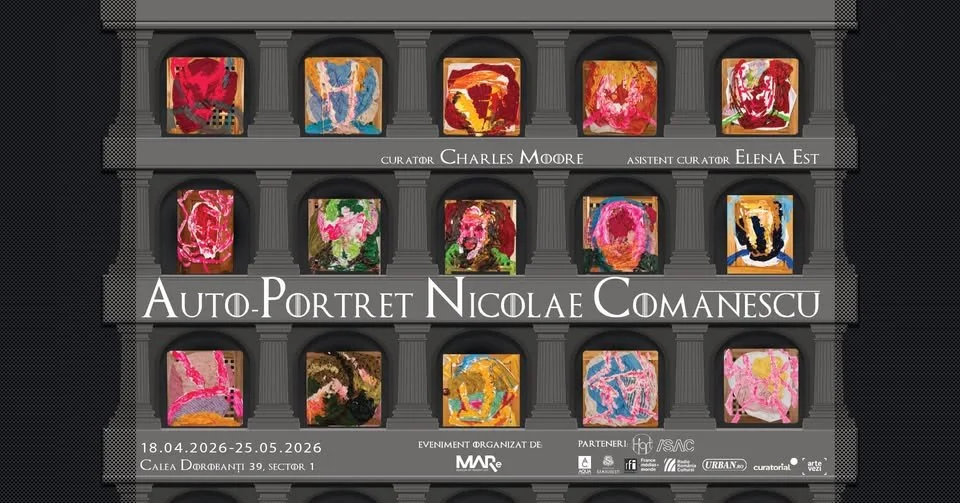
Self-Portrait: Nicolae Comănescu
April 18 — May 25, 2026
Curator: Charles Moore
Assistant Curator: Elena Est
There is a quiet insistence at the core of Nicolae Comănescu’s Self Portrait. It is a refusal to locate the self where we expect it to be. Nowhere in these works does the artist appear in any stable or recognizable form. Instead, the exhibition unfolds where identity is neither depicted nor fixed.
Comănescu insists on extending a lineage of painting in which the figure disintegrates into material, and perception overtakes likeness as the central concern. In this sense, his work forges a critical bridge back to the practice of Alberto Giacometti, for whom portraiture was less a matter of resemblance than of sustained looking. Like Giacometti, Comănescu embraces this failure of representation, allowing it to become generative. The portrait is no longer an image of a subject but the residue of an encounter that cannot be fully resolved.
Each work in Self Portrait begins with the presence of another person. Friends, collaborators, and acquaintances are invited to sit and pass time in conversation. What emerges, however, is not a portrait in the traditional sense. The figure dissolves almost immediately, displaced by color, texture, and the shifting emotional atmosphere of the encounter. Comănescu paints what circulates between bodies: fragments of memory. A bright recollection may register as a dense black surface; a moment of stillness may erupt into chromatic excess. The logic is more experiential than optical.
Portraiture is unmoored from resemblance. It becomes an index of shared time. Yet with each iteration, the boundary between self and other erodes. Every portrait carries as much information about the artist as it does about the person before him. The act of painting becomes reciprocal, even involuntary. To render another is also to reveal oneself, though never directly. Across more than two hundred works, this forms a collective self-portrait: a dispersed and unstable image of the artist, formed through relation.
Material plays a central role in this accumulation. Comănescu’s surfaces are already charged environments. Wooden panels, often repurposed from domestic furniture, are layered with textiles drawn from the lives of those around him. Clothing, worn and handled, carries the trace of bodies absent yet embedded within the work. These materials are not symbolic in any straightforward sense; they do not stand in for lived experience but are themselves splinters of it. Dust, fabric, and paint coalesce into dense strata, where personal histories coexist without hierarchy.
Painting, in turn, becomes a form of social archive. Rather than an archive of images, it is one of relations or of bodies moving through shared space. The works resist singular narratives, instead holding multiple, often contradictory realities in tension. The political and mundane circulate simultaneously, embedded within the same material field.
Emerging within this shifting terrain of Romania at the end of the 20th century, Comănescu developed a practice attuned to contradiction. That tension persists in Self Portrait, where accrual functions both as a method of grounding and a means of escape. The works are dense, often overwhelming in their material presence, yet they resist closure. There is no final image, no definitive statement of identity. Instead, the exhibition proposes a different understanding of the self, not as a coherent or singular entity, but as something formed through relation and time.
If there is an existential dimension to this work, it lies precisely here, in the recognition that the self cannot be fully known or represented, only approached through the traces it leaves behind. Comănescu does not attempt to resolve this condition. Rather, he inhabits it, allowing each painting to remain provisional.
What emerges across Self Portrait is accumulation. The self is built, slowly and collectively, through the accumulation of others. The exhibition offers not an image to be read, but an experience to be entered. The boundaries between artist, subject, and viewer begin to fracture, and identity is continuously formed.
—Charles Moore
Event organized by MARe/Museum of Recent Art; Partners: H’art Gallery and Contemporary Art Space /SAC
The works were created as part of the Rostopasca program, initiated by the Hearth/Casa KERIM association.
Graphic Design & Visual Identity: Oana Băndărău